
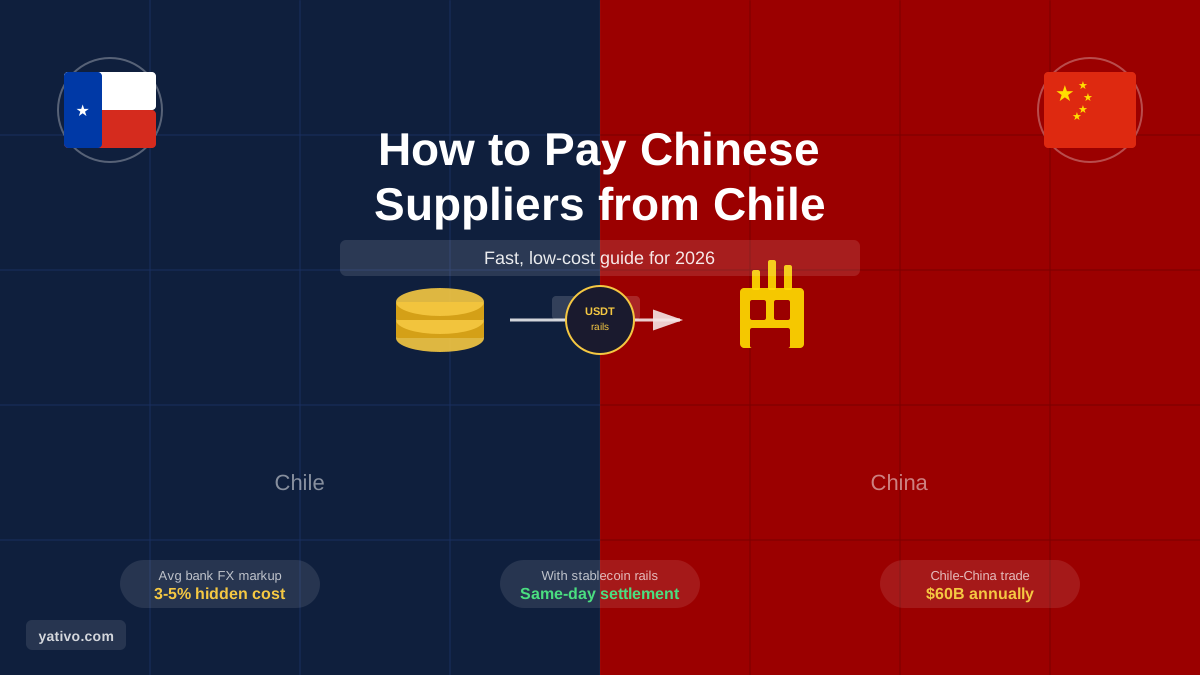
If your business imports from China, you already know the frustration. You initiate a wire transfer from your Chilean bank, wait several business days, watch an opaque FX rate quietly eat into your margins, and hope the payment doesn’t get stuck at a correspondent bank somewhere along the way.
This isn’t a niche problem. China is Chile’s largest trading partner, and Chile’s exports to China reached $37.8 billion in 2024, according to UN COMTRADE data. On the import side, Chilean businesses bring in close to $20 billion worth of Chinese goods each year; electronics, manufacturing inputs, consumer products, and more. With that volume of trade, payment friction isn’t a minor inconvenience. It’s a real cost center.
Yet most Chilean importers are still paying Chinese suppliers the same way they did 20 years ago: through slow, expensive SWIFT wires. This guide explains why that model is broken, what the alternative looks like, and exactly how to execute it; whether you’re making payments manually or building automated payout infrastructure.
Why Traditional Chile → China Payments Are So Painful
A standard bank wire from Chile to China involves more steps than most business owners realize:
- Your CLP is converted to USD
- Sent via SWIFT to your bank’s correspondent
- Routed through one or more intermediary banks
- Converted again into CNY before reaching your supplier
Each step adds time, fees, and FX spread. The total cost is rarely disclosed upfront.
The hidden cost breakdown:
- FX markup: Banks routinely apply a 2–4% markup over the mid-market exchange rate, which is never shown as a line-item fee; it’s simply baked into the rate you’re quoted. On a $50,000 supplier payment, that’s $1,000–$2,000 lost silently.
- Correspondent bank fees: International wire transfers often pass through 1–2 intermediary banks, each deducting their own fee mid-route often $10–$40 per hop without notifying either party.
- Sending fees: Your Chilean bank will also charge an outgoing wire fee, typically $15–$50 per transfer, on top of any intermediary charges.
- Settlement delays: Standard SWIFT transfers typically take 2–5 business days, and cross-border routes to China can push that to 7 days or longer when correspondent routing is complex.
- Limited payout methods: Many Chinese suppliers prefer Alipay or domestic bank transfers. SWIFT wires don’t support these, creating friction on the recipient’s side too.
Added up, a typical Chile-to-China wire can cost 3–6% of the transfer value once you account for FX markup, sending fees, and intermediary deductions before your supplier even receives the funds.
The Better Approach: Stablecoin Settlement Rails
Modern payment infrastructure solves this by using stablecoins as the settlement layer not as the final currency your supplier receives.
The flow looks like this:
CLP or USD → Stablecoin (USDT/USDC) → Local payout in China (CNY, Alipay, local bank)
Your supplier doesn’t need a crypto wallet or any knowledge of stablecoins. They receive CNY via their preferred local method. The stablecoin layer operates entirely in the background, replacing the correspondent bank chain that causes cost and delay.
What this changes in practice:
- Speed: Settlement moves from 3–7 days to same-day or next-day in most cases
- Cost transparency: You see the exact FX rate, fees, and recipient amount before you confirm no surprises
- Fewer intermediaries: Stablecoin rails remove the correspondent bank hops that generate hidden fees
- Supplier flexibility: Local payout methods (Alipay, CNY bank transfer) are natively supported
For a deeper look at how this infrastructure works, see Yativo’s guide on Stablecoins vs SWIFT vs Local Rails.
How to Pay Chinese Suppliers via Yativo
Option 1: Dashboard (for manual or occasional payments)
If you’re making one-off payments or just getting started, the Yativo dashboard gives you full control with no code required.
- Go to Transfer in your dashboard
- Select the customer or account to debit
- Choose your source currency – CLP or USD
- Select payout method – SWIFT, local bank transfer, or Alipay
- Enter recipient details – supplier name, bank, and account information
- Enter the amount in CLP or USD
- Review the quote – you’ll see the exact FX rate, total fees, estimated delivery time, and the amount your supplier will receive
- Confirm with PIN + 2FA
- Track the payment in real time from your dashboard
- Download the receipt for accounting and compliance
Option 2: API (for platforms automating supplier payouts at scale)
If you’re building a marketplace, ERP integration, or fintech platform that needs to process supplier payments programmatically, Yativo’s payout API gives you full control. You can explore all endpoints in the Yativo API documentation.
Step 1 – Discover available payout methods for China
GET /payment-methods/payout?country=CHN
Authorization: Bearer YOUR_API_KEY
Returns available payout methods, gateway IDs, and supported currencies for Chinese recipients.
Step 2 – Get required beneficiary fields
GET /beneficiary/form/show/{gateway_id}
Beneficiary forms are dynamic per payout method. This call returns the exact fields and validation rules for your chosen rail – no hardcoding required.
Step 3 – Create a beneficiary payment method
POST /beneficiaries/payment-methods/

{
  "gateway_id": 505,
  "nickname": "China Supplier",
  "customer_id": "uuid",
  "currency": "CNY",
  "payment_data": {
    "beneficiary_name": "Shenzhen Trading Co Ltd",
    "beneficiary_account": "1234567890",
    "beneficiary_bank_code": "999",
    "beneficiary_email": "su******@*****le.cn"
  }
}
Save this once and reuse it for every future payment to the same supplier — no re-entering details.
Step 4 – Initiate the payout
Fund from CLP:
POST /wallet/payout

{
  "debit_wallet": "CLP",
  "amount": 2500000,
  "payment_method_id": 12,
  "customer_id": "uuid"
}
Or fund from USD/stablecoin balance for faster settlement:
{
  "debit_wallet": "USD",
  "amount": 5000,
  "payment_method_id": 12,
  "customer_id": "uuid"
}
Step 5 – Track and reconcile
Use payout status webhooks to update your users in real time, trigger reconciliation workflows, or handle retries automatically.
Dashboard vs API: Which Should You Use?
| Dashboard | API | |
|---|---|---|
| Manual, one-off payments | ✅ | — |
| Automated bulk payouts | — | ✅ |
| Marketplace or platform integration | — | ✅ |
| No technical setup required | ✅ | — |
| Full programmatic control | — | ✅ |
Best Practices for Chile → China Payments
- Always review the FX quote before confirming. Rates fluctuate and a clear upfront quote is the first line of defense against cost surprises.
- Prefer local payout methods over SWIFT. CNY bank transfers and Alipay settle faster and are easier for Chinese suppliers to receive.
- Fund from USD/stablecoin balance when speed matters. Funding from a USD wallet bypasses the CLP-to-USD conversion step, reducing both time and cost.
- Save beneficiary records for repeat suppliers. Reusable payment methods eliminate re-entry errors and speed up recurring payments.
- Download receipts for every transaction. Maintaining a clean paper trail is essential for both accounting and cross-border compliance.
For more on managing FX risk in international supplier payments, see our guide on Hidden Costs of International Payments.
Frequently Asked Questions
How can I pay Chinese suppliers from Chile?
You can use a traditional SWIFT wire transfer through your Chilean bank, but modern platforms like Yativo use stablecoin settlement and local payout rails to deliver funds faster and at significantly lower cost.
Is it legal to use stablecoins for business payments in Chile?
Yes – when processed through a compliant infrastructure provider that handles on/off-ramps and regulatory requirements. Yativo is registered with the U.S. Financial Crimes Enforcement Network (FinCEN) as a Money Services Business under registration number 31000270723339, and compliance is built into every transaction.
What’s the fastest way to pay suppliers in China from Chile?
Stablecoin-backed infrastructure with local payout rails can reduce settlement from the typical 3–7 business days of SWIFT to same-day or next-day delivery, depending on the payout method selected.
Can my supplier receive payment via Alipay or local Chinese bank transfer?
Yes. Yativo supports multiple payout methods for China, including local CNY bank transfers and Alipay, so your supplier receives funds the way they prefer — without needing to interact with crypto at all.
Does my supplier need a crypto wallet?
No. Stablecoins are used purely as the settlement layer on the backend. Your supplier receives CNY fiat via their normal bank or payment app.
What currencies can I fund payments from?
Yativo supports CLP and USD as source currencies. Funding from a USD/stablecoin balance is generally faster since it skips the CLP conversion step.
Ready to Pay Your Chinese Suppliers Faster?
Chile and China do nearly $60 billion in annual trade. If your business is part of that flow, the gap between what you send and what your supplier receives – in money and in time is worth closing.
Yativo’s stablecoin-powered rails give you transparent pricing, same-day settlement options, and payout methods your Chinese suppliers actually want to receive.
Try the sandbox for free → — no setup costs, no commitment.