
Most guides on paying Chinese suppliers with stablecoins assume your supplier understands crypto. They talk about wallets, private keys, and blockchain networks as if your factory contact in Shenzhen is also a Web3 developer.
They are not. And they should not have to be.
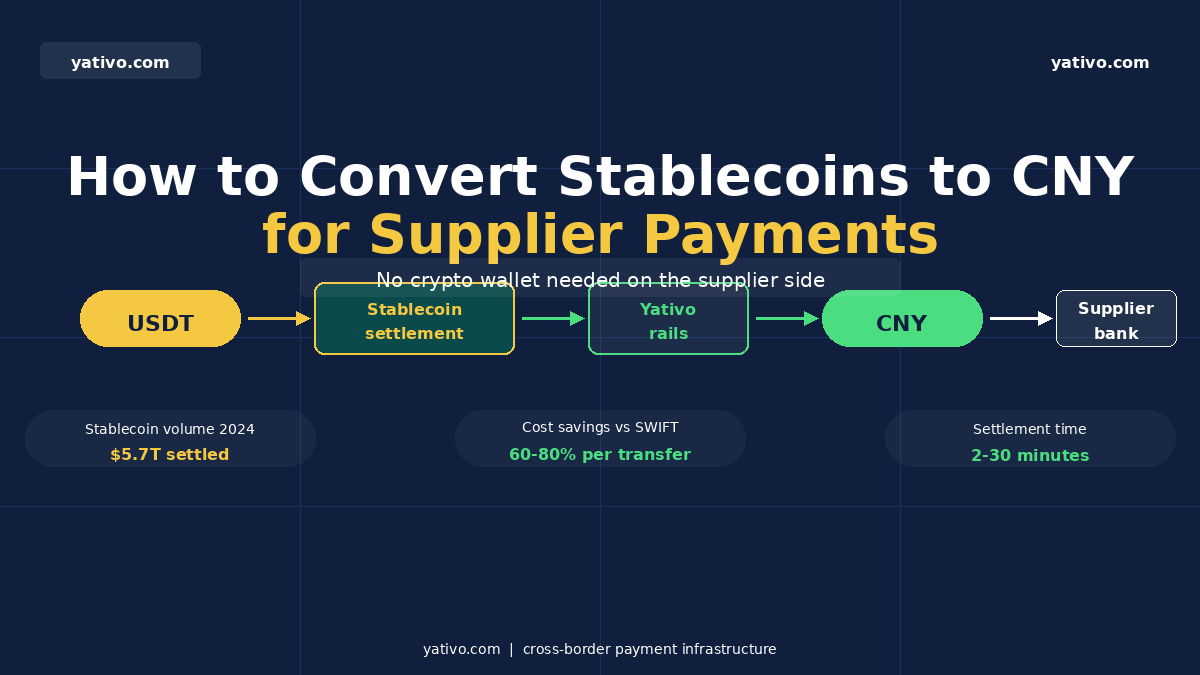
The reality is that stablecoins have become one of the most efficient settlement layers for cross-border B2B payments, and your supplier does not need to touch crypto at all. They receive CNY in their local bank account or via their preferred payment method. The stablecoin is the plumbing, not the user experience.
This guide covers exactly how converting USDT or USDC to CNY for Chinese supplier payments works in practice, what the flow looks like under the hood, how to execute it via dashboard or API, and what the compliance picture looks like in 2026.
Why Businesses Are Moving to Stablecoin-Powered Supplier Payments
Traditional SWIFT wires from Latin America, Africa, and Southeast Asia to China are slow, expensive, and opaque. A business sending $50,000 to a Chinese supplier via SWIFT can expect to lose 3-5% to FX markup and correspondent bank fees, wait 3-7 business days for settlement, and have no clear visibility into exactly how much will arrive until the supplier confirms receipt.
Stablecoin transaction volume hit $5.7 trillion in 2024 across 1.3 billion transactions, with B2B corridors accounting for a rapidly growing share of that volume. Stablecoin payments offer average cost savings of 60-80% compared to traditional wire transfers, including eliminated FX fees of 2-4%, reduced transfer costs from $25-50 down to $1-5, and faster settlement from 3-5 days to 2-30 minutes.
For businesses importing from China at scale, the math is straightforward. A company sending $1 million monthly to Chinese suppliers loses $20,000-$40,000 annually just to currency conversion fees on traditional rails. Stablecoin-powered infrastructure eliminates most of that.
What Happens Under the Hood
When you pay a Chinese supplier using Yativo’s stablecoin-powered rails, the flow looks like this:
- You fund the payment from your local currency (CLP, USD, MXN, or another supported wallet)
- Yativo converts to USDT or USDC and moves value on-chain
- A licensed local payout partner in China receives the stablecoin settlement
- The partner converts to CNY and delivers to your supplier via local bank transfer or Alipay
- Your supplier receives CNY in their normal bank account
Your supplier never sees, holds, or manages stablecoins. They receive CNY fiat, same as any other bank transfer. The stablecoin layer operates entirely in the background, replacing the correspondent bank chain that normally causes delays and cost leakage.
This is sometimes called the “stablecoin sandwich”: local currency in, stablecoin settlement in the middle, local currency out.
The Compliance Picture in 2026
One of the most common questions businesses ask is whether using stablecoins to pay Chinese suppliers is legal. The answer depends on where the compliance sits.
On the mainland China side: Stablecoins like USDT and USDC are formally banned within mainland China, as the People’s Bank of China views them as a threat to capital controls. However, the ban applies to holding and trading stablecoins inside China, not to receiving CNY fiat payments that were settled via stablecoins outside China. Your supplier receives CNY from a licensed local payout partner, which is a normal domestic bank transfer on their end.
On the Hong Kong side: Hong Kong passed its Stablecoins Ordinance in May 2025, which took effect August 1, 2025, establishing a comprehensive licensing regime for stablecoin issuers. Hong Kong serves as the regulated gateway for stablecoin-to-CNY settlement flows, with over 40 institutions applying for licenses including major Chinese financial institutions.
On the sender’s side: Yativo is registered with the U.S. Financial Crimes Enforcement Network (FinCEN) as a Money Services Business under registration number 31000270723339. All transactions go through KYC and AML screening. Compliance is built into the infrastructure, not bolted on afterward.
The practical result: your supplier receives a normal domestic CNY payment. You send funds through a compliant, licensed infrastructure provider. The stablecoin layer in the middle is handled by regulated parties.
USDT vs USDC: Which Should You Use?
Both USDT and USDC are widely used for B2B supplier payments to China. The main differences:
| USDT (Tether) | USDC (Circle) | |
|---|---|---|
| Market size | $184B+ circulating supply | Smaller, growing |
| Supplier acceptance | Highest, widely accepted | High, growing |
| Best network for China | Tron (TRC-20), low fees | Ethereum (ERC-20) or Solana |
| Transparency | Improving, faces some scrutiny | Monthly third-party audits |
| Settlement speed | 2-30 minutes | 2-30 minutes |
For most B2B supplier payment use cases, USDT on the Tron network (TRC-20) is the most widely accepted by Chinese suppliers, with transaction fees under $1. Yativo handles network selection automatically based on the payout destination and method.
How to Convert Stablecoins to CNY via Yativo
Option 1: Dashboard (for manual payments)
- Go to Transfer in your Yativo dashboard
- Select the customer or account to debit
- Select source currency: USD (stablecoin wallet) or local currency (CLP, MXN, etc.)
- Choose payout method for China: local bank transfer or Alipay
- Enter supplier details: name, bank account, and bank code
- Enter the amount in USD or local currency
- Review the quote: see the exact USDT/CNY conversion rate, fees, and the CNY amount your supplier will receive
- Confirm with PIN + 2FA
- Track in real time from your dashboard
- Download receipt for accounting and compliance
Option 2: API (for automated bulk payouts)
All endpoints are available in the Yativo API documentation.
Step 1: Get available payout methods for China
GET /payment-methods/payout?country=CHN
Authorization: Bearer YOUR_API_KEY
Step 2: Get required beneficiary fields
GET /beneficiary/form/show/{gateway_id}
Step 3: Create supplier beneficiary
POST /beneficiaries/payment-methods/

{
  "gateway_id": 505,
  "nickname": "Shenzhen Supplier",
  "customer_id": "uuid",
  "currency": "CNY",
  "payment_data": {
    "beneficiary_name": "Guangzhou Trading Co Ltd",
    "beneficiary_account": "1234567890",
    "beneficiary_bank_code": "999",
    "beneficiary_email": "su******@*****le.cn"
  }
}
Step 4: Initiate payout from stablecoin wallet
POST /wallet/payout

{
  "debit_wallet": "USD",
  "amount": 5000,
  "payment_method_id": 12,
  "customer_id": "uuid"
}
Funding from USD/stablecoin balance skips the local currency conversion step, making it the fastest path to CNY settlement.
Step 5: Track and reconcile
Use webhooks to monitor payout status, trigger reconciliation, and update your supplier records automatically.
Best Practices
Fund from USD/stablecoin wallet for fastest settlement. Payments funded directly from a USD balance skip the local currency conversion step, reducing both time and cost.
Always review the CNY conversion rate before confirming. Yativo shows you the exact rate and recipient amount upfront. Lock the rate when you confirm.
Save supplier beneficiary details once. Reusable beneficiary records eliminate re-entry errors and speed up recurring payments to the same suppliers.
Use Alipay for smaller suppliers, local bank transfer for larger ones. Alipay tends to be faster for smaller amounts and is preferred by many smaller Chinese suppliers. For larger B2B payments, local bank transfer is more appropriate.
Download receipts for every transaction. Cross-border payments involving stablecoins require clean documentation for compliance and accounting purposes.
For more on the full SWIFT vs stablecoin cost comparison, see our guide on Hidden Costs of International Payments.
Frequently Asked Questions
Does my Chinese supplier need a crypto wallet to receive payment?
No. Your supplier receives CNY via their normal local bank account or Alipay. They do not need to interact with stablecoins, set up a wallet, or understand how blockchain works.
Is it legal to pay Chinese suppliers using stablecoins?
Yes, when done through a compliant, licensed infrastructure provider. Stablecoins are used as the settlement layer outside China. Your supplier receives a standard CNY domestic transfer from a licensed local payout partner. Yativo is registered with FinCEN as a Money Services Business.
How long does USDT to CNY conversion and delivery take?
Typically same-day to next-day for most corridors. Stablecoin settlement itself takes 2-30 minutes. Local payout delivery time depends on the payout method and banking cut-off times in China.
What exchange rate do I get for USDT to CNY?
Yativo shows you the exact conversion rate before you confirm, based on current market rates with our stablecoin-powered FX engine. There are no hidden markups baked into the rate after you confirm.
Which is better for paying Chinese suppliers, USDT or USDC?
For most use cases, USDT on Tron (TRC-20) offers the widest supplier acceptance and lowest transaction fees. Yativo selects the optimal network and stablecoin automatically based on your payout destination.
What currencies can I fund payments from?
Yativo supports USD (stablecoin wallet), CLP, MXN, and other supported local currencies as funding sources. Funding from USD is fastest. Funding from local currency adds one FX conversion step.
Start Paying Suppliers in China with Stablecoins
Stablecoin-powered supplier payments are not a future technology. Stablecoin transaction volume hit $5.7 trillion in 2024, and B2B corridors are among the fastest-growing segments. Businesses importing from China are already using this infrastructure to cut payment costs by 60-80% and reduce settlement time from days to hours.
Yativo gives you the full stack: stablecoin-powered FX, local CNY payout rails, compliance built in, and a developer-friendly API for platforms that need to automate at scale.
Try the sandbox for free and process your first test payment to China today.