
Most businesses think they know what international payments cost. They see the wire fee on their bank statement and move on.
That wire fee is the least of your problems.
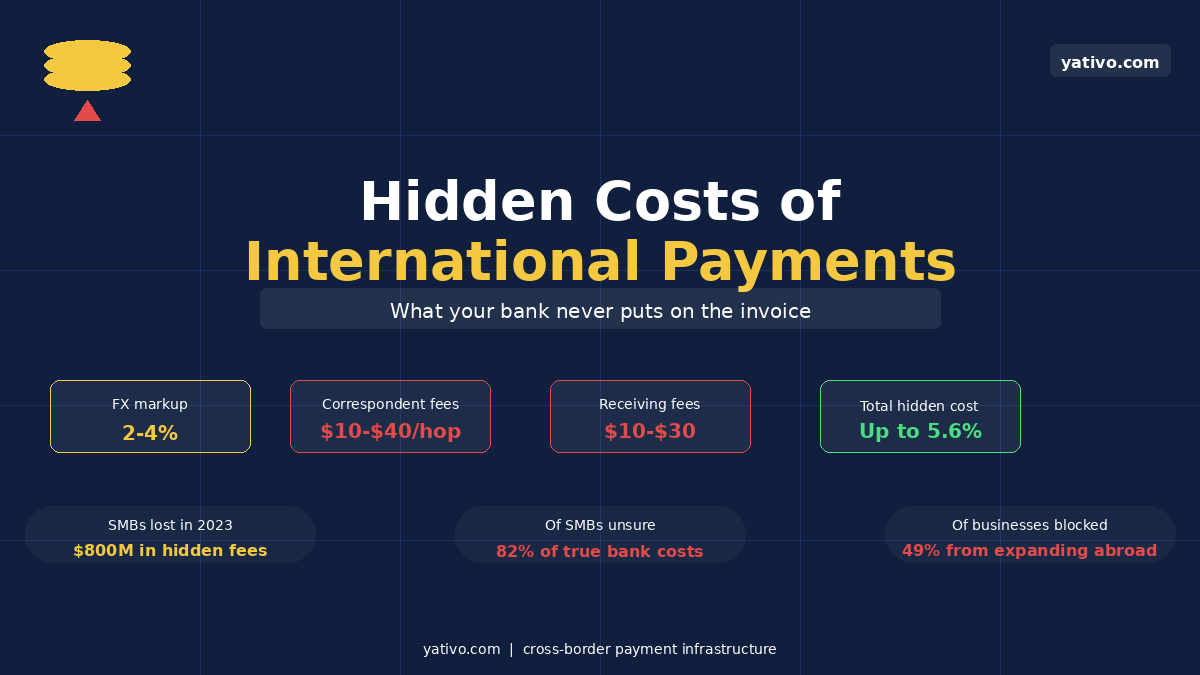
US small and medium-sized businesses lost an estimated $800 million to hidden fees on international payments in 2023 alone, according to research by Wise and Capital Economics. And 82% of SMB leaders either do not believe their bank is transparent about cross-border payment costs, or are not sure what they are actually being charged.
That is not a billing error. That is the system working exactly as designed, just not in your favor.
This guide breaks down every layer of cost in an international payment, why most of them never appear on an invoice, and what businesses in Latin America and emerging markets can do to stop paying them.
The Visible Cost: What Your Bank Actually Tells You
When you initiate an international wire transfer, your bank shows you one number: the outgoing transfer fee. Depending on your bank and the destination country, this typically ranges from $15 to $50 per transaction.
That number looks manageable. For a $10,000 supplier payment, a $30 wire fee feels like 0.3%. Acceptable.
But that $30 is just the entry ticket. The real costs are buried deeper.
The Hidden Costs Nobody Tells You About
1. FX markup
This is the biggest hidden cost in international payments, and almost no one talks about it.
When your bank converts your currency for an international transfer, they do not use the real mid-market exchange rate (the one you see on Google or XE). They use their own rate, which includes a markup of 2-4% above the true mid-market rate.
This markup is never shown as a line item. It is baked invisibly into the exchange rate you are quoted. On a $50,000 payment, a 3% FX markup costs you $1,500 that never appears on any fee statement.
For businesses making regular cross-border payments, this is where the real money leaks.
2. Correspondent bank fees
International wire transfers rarely travel in a straight line from your bank to your recipient’s bank. They often pass through one or two intermediary (correspondent) banks along the way, each of which deducts its own fee from the transferred amount, typically $10-$40 per hop.
Here is the critical detail: these fees are deducted from the principal. So your recipient gets less than you sent, and neither party knew in advance how much would be deducted. You only find out when your supplier calls to say the payment was short.
3. Receiving bank fees
On top of what correspondent banks take, the recipient’s own bank often charges an inward remittance fee for processing the incoming international wire. This is another $10-$30 deducted from the final amount.
By the time a payment completes the full correspondent chain, the total cost of an international wire can reach 3-8% of the transfer value for smaller businesses, according to analysis cited in McKinsey’s Global Payments Report 2024.
4. Payment repair fees
When a payment message contains errors or incomplete information, it fails straight-through processing and requires manual intervention. Banks charge repair fees for this, and in regions with complex payment ecosystems like Latin America and Africa, straight-through processing rates can drop to 80-85%, meaning up to 1 in 5 payments requires a manual fix.
Each repair takes 30 minutes to several hours of staff time, and can delay settlement by a business day or more.
5. FX conversion at both ends
Many corridors involve two currency conversions: your local currency to USD, and then USD to the recipient’s local currency. Each conversion carries its own spread. In markets like Latin America and Southeast Asia, where local currencies are not freely tradeable, these spreads can be wider than in major currency pairs.
A payment from CLP to CNY, for example, may go through two separate FX events, compounding the markup at each step.
6. Opportunity cost of delayed settlement
SWIFT wire transfers typically take 2-5 business days to settle, and complex cross-border routes in emerging markets can push that to 7 days or longer. That is capital sitting idle, unavailable for operations, investment, or supplier relationships.
For a business sending $500,000 a month in supplier payments, even 3 days of float represents meaningful opportunity cost.
7. Compliance and documentation overhead
Cross-border payments in many corridors require supporting documentation: contracts, invoices, purpose-of-payment codes, and in some jurisdictions, prior approval from regulatory authorities. The internal staff time spent preparing, submitting, and tracking this paperwork is a real cost, even if it never appears on a bank statement.
What It Actually Adds Up To
Let’s put a number on it. A business sending $10,000 internationally via a traditional bank wire might face:
| Cost component | Typical range |
|---|---|
| Outgoing wire fee | $30-$50 |
| FX markup (2-4%) | $200-$400 |
| Correspondent bank fees | $20-$80 |
| Receiving bank fee | $10-$30 |
| Total hidden cost | $260-$560 |
That is 2.6% to 5.6% of the transfer value, on top of the wire fee you actually saw.
For a company processing $1 million per month in international payments, that is $26,000 to $56,000 per month in costs that never appear as a line item anywhere.
Why Emerging Market Corridors Are Worse
Everything above applies to major currency corridors. In emerging markets, the problem compounds.
Latin America, Southeast Asia, and Africa involve currencies that are restricted, illiquid, or subject to capital controls. This means:
- Wider FX spreads, because local currency liquidity is thinner
- More correspondent hops, because fewer banks have direct relationships in these markets
- Higher compliance overhead, because regulators in these markets often require documentation that major currency transfers do not
- Lower STP rates, meaning more repairs, more delays, more fees
Mexican SMEs alone lost approximately $446 million in hidden fees on cross-border transfers in 2024. And 49% of SMB leaders globally say the complexity of international payments prevents them from expanding their operations abroad.
The cost of bad payment infrastructure is not just financial. It is a barrier to growth.
How Modern Infrastructure Cuts These Costs
The reason these hidden costs exist is the correspondent banking model. Every intermediary in the chain takes a cut, applies its own FX spread, and adds its own processing time.
Modern payment infrastructure removes intermediaries by using alternative settlement rails, including local bank networks, real-time payment systems, and stablecoin-powered settlement layers.
Here is how the cost structure changes:
Local rails: Instead of routing through SWIFT and correspondent banks, payments settle directly on domestic banking infrastructure in the recipient’s country. No intermediary hops, no per-hop fees.
Transparent FX: Modern platforms show you the exact exchange rate and fee structure before you confirm a payment. What you see is what gets deducted.
Stablecoin settlement: For corridors where local rails are not available or where speed is critical, stablecoins like USDT and USDC act as the settlement layer. Value moves on-chain instantly, and recipients receive local currency via a local payout partner. No correspondent bank chain required.
Pre-validated payment data: Modern APIs validate beneficiary information before submission, dramatically reducing repair rates and the fees that come with them.
A Practical Checklist: Where to Look for Hidden Costs in Your Payments
If you want to audit what your business is actually paying for international transfers, here is where to look:
Check the exchange rate you are being quoted against the mid-market rate on XE.com or Google at the exact time of the transaction. The difference is your FX markup.
Check the amount your recipient received against what you sent. The shortfall, minus any disclosed fees, is what correspondent and receiving banks deducted.
Add up your repair and investigation fees from your bank statements. These are often listed under vague labels like “payment investigation” or “trace fee.”
Calculate your average settlement time across your payment corridors. Each day of delay has an opportunity cost you can quantify.
Review your compliance overhead by estimating staff hours spent on payment documentation per month.
For most businesses, this audit reveals that the visible wire fee is a fraction of the total cost of sending money internationally.
Frequently Asked Questions
What are the hidden costs of international payments?
Beyond the visible wire transfer fee, international payments typically carry FX markup (2-4% above mid-market rates), correspondent bank fees ($10-$40 per hop), receiving bank fees, repair fees for failed straight-through processing, and opportunity costs from delayed settlement. Together these can add 3-8% to the true cost of a transfer.
Why does my recipient receive less than I sent?
Correspondent and receiving banks deduct their fees directly from the transfer amount, not from the sender’s account separately. This means the recipient receives less than what was sent, and neither party knows the exact deduction in advance.
What is an FX markup and how do I calculate it?
An FX markup is the difference between the true mid-market exchange rate and the rate your bank or payment provider applies. To calculate it, compare the rate you received to the real-time rate on XE.com or Google at the moment of the transaction. The difference, expressed as a percentage, is your markup.
Are hidden payment costs worse in Latin America?
Yes. Emerging market corridors, including those in Latin America and Southeast Asia, typically have wider FX spreads, more correspondent bank hops, higher compliance requirements, and lower straight-through processing rates than major currency corridors, all of which increase the total cost of a transfer.
How can I reduce the hidden costs of international payments?
Using payment infrastructure that offers transparent FX pricing, local settlement rails, and stablecoin-powered corridors can significantly reduce or eliminate most of these hidden costs. Platforms like Yativo show you the full cost before you confirm a payment and use local payout networks that bypass the correspondent banking chain.
Stop Paying for a Broken System
The correspondent banking model was built for a world where international payments were rare, high-value, and institutional. It was not designed for businesses that send dozens of supplier payments a month across multiple countries.
Every FX markup, every correspondent fee, every repair charge is a tax on using infrastructure that has not kept up with how global business actually works today.
Yativo’s payment infrastructure gives you transparent pricing, local rails, and stablecoin-powered settlement for corridors where speed matters most. Book a demo to see what your business is currently paying and what it could be paying instead.