
Your field agents in Accra are paid in cedis, mostly to mobile money. Your treasury is in USDC, and every exchange cash-out adds days and a fresh spread.
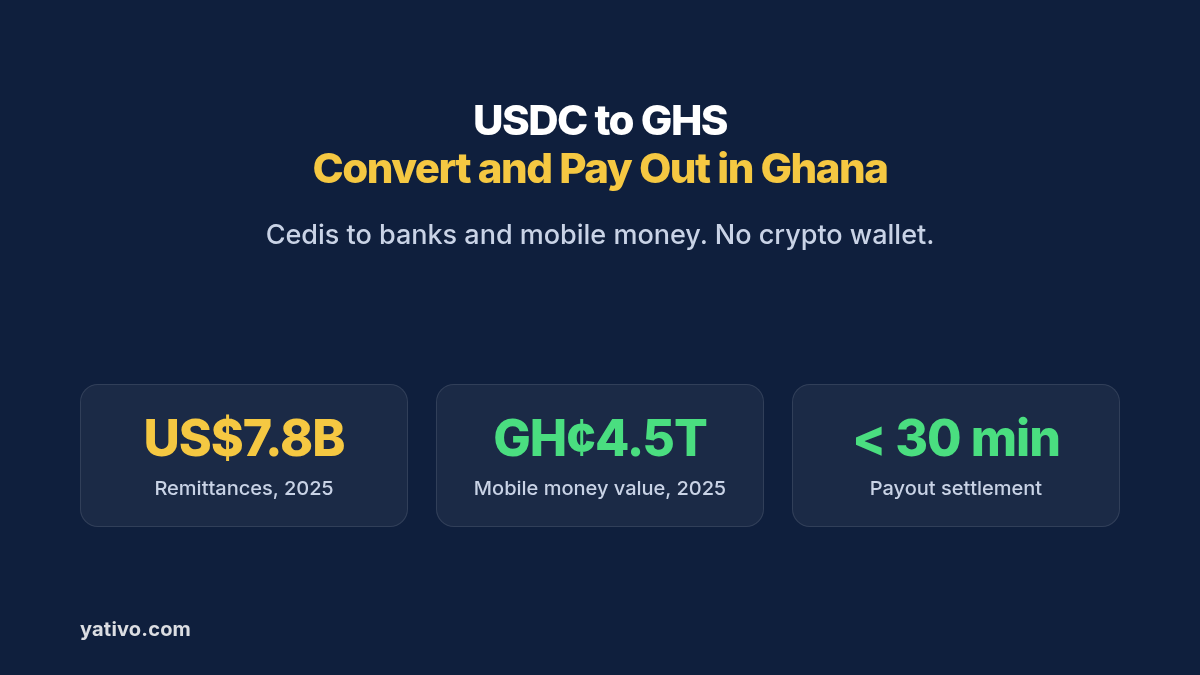
Converting USDC to GHS through Yativo is one payout. You lock a quote, and your recipient gets Ghanaian cedis in their bank account or mobile money wallet in under 30 minutes.
Ghana received a record nearly US$7.8 billion in remittances in 2025. Mobile money alone moved about GH¢4.5 trillion in 2025, so wallets are where most recipients want their cedis.
This guide shows how USDC to GHS conversion works on Yativo, which local rails you can use, and what to collect from recipients. It ends with dashboard steps and a full API example.
What It Means to Convert USDC to GHS and Pay Out Locally
Converting USDC to GHS means turning a dollar-backed stablecoin balance into Ghanaian cedis that lands in a real local account. People call this an off-ramp. The hard part is not the conversion itself. It is getting the money to the right bank account or mobile money wallet quickly and at a known rate.
Most businesses that hold USDC want one of two outcomes. They want to pay someone in Ghana, such as a supplier, a contractor or an employee. Or they want to move their own treasury into GHS for local costs.
Yativo handles both with one flow. You hold USDC or USD in your float balance. When you send a payout, Yativo converts the value and a licensed local payout partner credits GHS over a local rail such as Local Payout and Mobile Money.
Why Converting USDC to GHS Through an Exchange Is Harder Than It Looks
Selling USDC on an exchange looks simple on screen. In practice it adds steps between your balance and your recipient.
Two hops instead of one. You sell on the exchange, withdraw GHS to your own bank, then send a second transfer to the recipient. Each hop adds time, limits and another point of failure.
Spreads and withdrawal fees stack up. The quoted price on an order book is rarely what you net after spreads and withdrawal charges. Sending small amounts across borders already costs an average of 6.36% of the amount sent, according to the World Bank.
Banks may question the funds. Some banks ask for extra documents when money arrives from a crypto exchange. That review can freeze the payment you needed to make today.
Wallets and banks need different details. Paying a mobile money wallet takes a phone number and network, while a bank needs an account number. One integration that handles both saves rework.
We break down more of these costs in the hidden costs of international payments.
How USDC to GHS Conversion Works with Yativo
Yativo is payment infrastructure, not a bank or an exchange. We use stablecoins as the settlement layer, and a licensed local payout partner delivers the GHS on a domestic rail.
- You fund your Yativo float balance with a fiat or stablecoin deposit, such as USDC.
- You request a quote that shows the rate, the fees and the exact GHS amount.
- Yativo settles the payout value on-chain with a licensed local payout partner in Ghana.
- The partner converts the stablecoin to GHS and sends a local payment to the recipient’s bank account or mobile money wallet.
- Your recipient sees Ghanaian cedis in their account like any other domestic credit.
Your recipient does not need a crypto wallet. They never see or touch stablecoins. On their side, the payment looks like a normal local GHS transfer.
On the local side, GhIPSS Instant Pay credits bank accounts in real time, 24/7. For the wider picture, read our overview of the on-ramp and off-ramp API for businesses and how to receive international payments in stablecoins.
Local Rails for USDC to GHS Payouts
Ghana has one local payout gateway that covers banks and mobile money, a dedicated mobile money gateway, and SWIFT. See our Ghana bank and mobile money guide and Ghana mobile money guide.
Local Payout GHS (gateway ID 871)
Gateway 871 pays cedis to both Ghanaian bank accounts and mobile money wallets under one method. It is the broadest way to turn USDC into GHS.
Required details: the fields returned by the form for gateway 871. Expect the recipient name and either a bank and account number or a mobile number and network.
Settlement time: Under 30 minutes.
Limits: 20 GHS minimum and 50,000,000 GHS maximum per payout in our catalog.
Best for: mixed payout runs to banks and wallets, suppliers and payroll.
Mobile Money (GH) (gateway ID 1321)
Gateway 1321 pays mobile money wallets directly. Use it for gig workers, agents and small contractor payouts.
Settlement time: Under 30 minutes.
Limits: 20 GHS minimum and 15,000 GHS maximum per payout in our catalog.
SWIFT (USD)
If your recipient prefers dollars, SWIFT gateway 596 delivers USD to their bank account instead.
Settlement time: T+1 (next business day).
Limits: 20 USD minimum and 1,000,000 USD maximum per payout in our catalog.
What You Need Before Your First USDC to GHS Payout
The form in your dashboard, or the authenticated GET /beneficiary/form/show/871 call, is the authoritative field list. For field details, see API documentation. Collect the items below before you send.
- A verified Yativo business account. KYB must be complete before you can pay out.
- A funded balance. Deposit USDC or fiat into your float balance. USDC deposits credit your balance once confirmed on-chain.
- The customer record, if you are a fintech. Payouts made on behalf of a customer need that customer’s ID.
- Mobile number and network, for wallets. Confirm the number is registered to the recipient’s own name.
- Bank and account number, for bank payouts. Ask for both from a statement or banking app.
- A payment reference. An invoice number or payroll period helps the recipient reconcile the credit.
Wallet limits depend on the recipient’s account level. Ask large recipients to use a bank account, or upgrade their wallet before you pay.
How to Convert USDC to GHS and Pay Out via Yativo
Option 1: Dashboard (for manual payouts)
- Fund your Yativo float balance with either a fiat or a stablecoin deposit, such as USDC.
- Go to Transfer in your Yativo dashboard.
- Select the float wallet you are paying with, for example USD, EUR, MXN or whichever balance you funded.
- Choose the customer you are paying on behalf of. This step is necessary for fintechs that run payouts on behalf of their customers.
- Choose Ghana as the destination and Local Payout GHS as the payout method.
- Enter the recipient details the payout form asks for, such as the recipient name and their bank account or mobile number.
- Enter the amount in USD or GHS.
- Review the quote: exchange rate, fees, delivery time and the exact GHS amount your recipient receives.
- Confirm with your PIN and 2FA.
- Track the payout in real time and download the receipt for your records.
Option 2: API (for automated and bulk payouts)
Every endpoint below is in the Yativo API documentation. Production calls go to https://api.yativo.com/api/v1, and the sandbox runs at https://smtp.yativo.com/api/v1.
Authenticate every request with the X-Api-Key and X-Api-Secret headers. Each key only works from the server IPs listed on it. These keys replaced bearer tokens, as covered in our October update. Every POST also needs a unique Idempotency-Key header.
Step 1. Generate a USDC deposit address on Solana to fund your balance:
POST https://api.yativo.com/api/v1/crypto/create-wallet
X-Api-Key: $YATIVO_API_KEY
X-Api-Secret: $YATIVO_API_SECRET
Idempotency-Key: cbda5f09-2be5-4ad4-8640-cf205aea112e
Content-Type: application/json

{
  "currency": "USDC_SOL"
}
Step 2. List the payout methods available for Ghana:
curl "https://api.yativo.com/api/v1/payment-methods/payout?country=GHA" \
  -H "X-Api-Key: $YATIVO_API_KEY" \
  -H "X-Api-Secret: $YATIVO_API_SECRET" \
  -H "Accept: application/json"
Local Payout GHS carries gateway ID 871. Always read the ID from the live response instead of hardcoding it.
Step 3. Fetch the required fields for that gateway:
GET https://api.yativo.com/api/v1/beneficiary/form/show/871
X-Api-Key: $YATIVO_API_KEY
X-Api-Secret: $YATIVO_API_SECRET
The response lists every required field and its accepted values. Build your payment_data object from it.
Step 4. Create the beneficiary. Replace the placeholder with the fields the form returned:
POST https://api.yativo.com/api/v1/beneficiaries/payment-methods/
X-Api-Key: $YATIVO_API_KEY
X-Api-Secret: $YATIVO_API_SECRET
Idempotency-Key: 1707d42e-4c4e-41a8-a2aa-76cfc843452c
Content-Type: application/json

{
  "gateway_id": 871,
  "nickname": "Mensah Field Services",
  "currency": "GHS",
  "customer_id": "e8caa491-57b6-4c39-9e3a-d2c97e47fbf0",
  "payment_data": {
    "{field_from_form}": "{value}"
  }
}
Step 5. Lock your GHS rate. Quotes hold for 5 minutes:
POST https://api.yativo.com/api/v1/exchange-rate
X-Api-Key: $YATIVO_API_KEY
X-Api-Secret: $YATIVO_API_SECRET
Idempotency-Key: a608fdc6-2f4d-4726-a69e-fb7a78949ca7
Content-Type: application/json

{
  "from_currency": "USD",
  "to_currency": "GHS",
  "method_id": 871,
  "method_type": "payout",
  "amount": 800
}
Step 6. Initiate the payout from your balance:
POST https://api.yativo.com/api/v1/wallet/payout
X-Api-Key: $YATIVO_API_KEY
X-Api-Secret: $YATIVO_API_SECRET
Idempotency-Key: 3b9db9a2-5d06-40d6-982d-51f9a9656516
Content-Type: application/json

{
  "debit_wallet": "USD",
  "amount": 800,
  "payment_method_id": 6566,
  "customer_id": "e8caa491-57b6-4c39-9e3a-d2c97e47fbf0",
  "quote_id": "4a72ecf8-6c8a-4e38-9971-8aabe9f785ed"
}
Use the id from the beneficiary response as payment_method_id. For bulk runs, repeat the call per beneficiary, as described on our payouts page.
Yativo vs an Exchange vs a SWIFT Wire for USDC to GHS
| Yativo off-ramp | Exchange sale + bank withdrawal | SWIFT wire | |
| Steps to reach the recipient | One payout | Sell, withdraw, then transfer again | One wire through correspondent banks |
| Settlement | Under 30 minutes | Depends on the exchange and your bank | T+1 or longer |
| GHS amount known upfront | Yes, in the quote | Only after the trade and fees | Often not, intermediaries may deduct fees |
| Recipient needs crypto | No | No, but you need an exchange account | No |
| Best for | Paying people in Ghana from USDC | Occasional personal conversions | Large payments with no local rail |
Best Practices for Converting USDC to GHS
Lock the rate on large payouts. Quotes hold for 5 minutes, so request one right before you approve a big GHS payment.
Validate details at onboarding. Check account formats in your own form before you save a beneficiary. Most failed payouts start with a typo.
Match the name to the account. Use the exact legal name the bank account or mobile money wallet is registered under. Mismatches can trigger compliance holds.
Keep a USDC buffer. Hold enough balance for your next payout cycle so on-chain confirmation time never delays a payment run.
Route by amount. Mobile Money 1321 caps at 15,000 GHS per payout, so send larger sums through Local Payout 871 to a bank account.
Use idempotency keys everywhere. A unique Idempotency-Key on every POST stops a retry from sending the same payout twice.
Frequently Asked Questions
Does my recipient need a crypto wallet to receive GHS?
No. Your recipient gets Ghanaian cedis in their normal bank account or mobile money wallet. They never touch USDC, and the credit looks like any other domestic payment.
Is converting USDC to GHS this way legal and compliant?
Yes, when it runs through regulated infrastructure. Yativo is registered with FinCEN as a Money Services Business, registration number 31000270723339. A licensed local payout partner handles the GHS leg. Your own tax and reporting duties still apply, so confirm them with your advisor.
How long does a USDC to GHS payout take?
Local Payout and Mobile Money payouts to Ghana settle in under 30 minutes. SWIFT payouts in USD settle T+1.
What exchange rate do I get when I convert USDC to GHS?
You see the rate, the fees and the exact GHS amount before you confirm. Quotes from the exchange-rate endpoint hold for 5 minutes, so you can lock a rate before you approve a large payout.
Do I need an exchange account to convert USDC to GHS?
No. You deposit USDC into your Yativo balance and pay out directly on a local rail. There is no separate exchange order, withdrawal request or bank transfer to manage.
Can one integration pay both banks and wallets?
Yes. Local Payout 871 pays bank accounts and mobile money wallets under one method. The form tells you which fields each one needs.
Start Converting USDC to GHS with Yativo
Ghana took in nearly US$7.8 billion in remittances in 2025, and most of it lands in wallets. Yativo turns your USDC into GHS through a licensed local payout partner in under 30 minutes. Book a demo to set up your first GHS payout, or contact sales if you already know your monthly volume.
Sources
- Ghana News Agency: Record US$7.8 billion in remittances shows value of Ghanaians abroad
- MyJoyOnline: Total value of mobile money transactions for 2025 hits GHC 4.5 trillion
- GhIPSS: GhIPSS Instant Pay (GIP)
- World Bank: Remittance Prices Worldwide
- Yativo: Yativo API Documentation
- Yativo: Safer API access, three new virtual accounts and new payment links