
Your contractor in Buenos Aires sent the invoice on Monday. By Thursday the wire still has not landed, and when it does, it will arrive short.
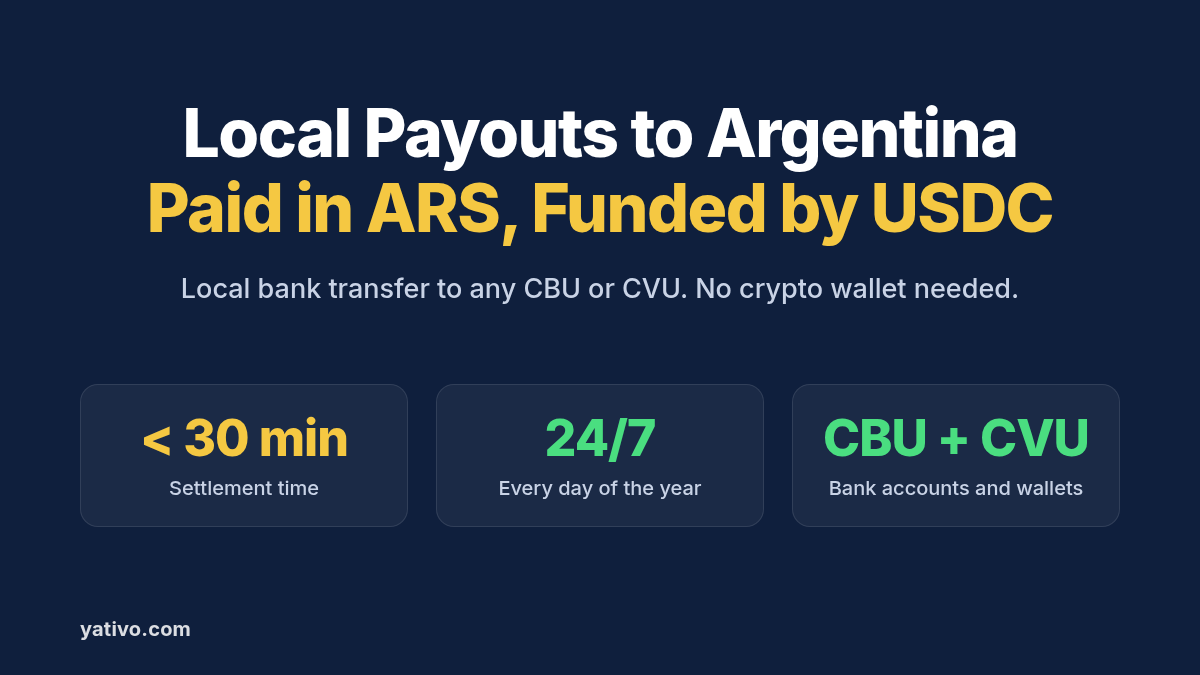
There is a better way. With local bank transfer payouts to Argentina, stablecoin settlement replaces the correspondent chain. You fund in USDC or USD, and your recipient gets Argentine pesos (ARS) in their own CBU or CVU account.
The demand is real. Argentina imported US$75.8 billion in goods in 2025, up 24.7% year on year, and exported US$87.1 billion. Every one of those trade relationships needs suppliers, agents and service providers paid on time.
This guide covers why Argentina payouts break, how the stablecoin-funded flow works, and which recipient details you need. It then walks through your first ARS payout by dashboard and by API.
Why Paying Out in Argentina Is Harder Than It Should Be
Argentina has fast domestic payment rails. The pain sits at the border, where your foreign payment meets local rules and a fast-moving peso.
Prices move fast. Consumer prices rose 33.5% in the 12 months to August 2026, according to INDEC, Argentina’s statistics office. A payout that lands days late is worth less to the person receiving it.
The peso trades inside a managed band. On September 30, 2026, the wholesale rate closed at ARS 1,517 per dollar. That sat inside the central bank’s band of ARS 724.28 to ARS 1,919.40, Diario Uno reported. Your quote needs to be firm before you send, not after.
Small cross-border transfers are expensive. Sending small amounts abroad costs an average of 6.36% of the amount sent, according to the World Bank. On a US$50,000 monthly contractor payroll, that average would cost you US$3,180 every month.
The details have to be exact. Argentine accounts are identified by a 22-digit CBU at banks or a 22-digit CVU at payment providers. A wrong digit or a mismatched tax ID is the fastest route to a failed payout. We break down more of these fees and failure points in the hidden costs of international payments.
Local Bank Transfer Payouts to Argentina with a Stablecoin Layer: How It Works
Yativo is payment infrastructure, not a bank. We use stablecoins as the settlement layer between your balance and Argentina. A licensed local payout partner then delivers the pesos on the ground, the same model we use for paying suppliers in China without SWIFT.
- You fund your Yativo float balance with a fiat or stablecoin deposit, such as USDC.
- Yativo converts the payout value to USDC and settles it on-chain.
- A licensed local payout partner in Argentina receives the stablecoin settlement.
- The partner converts USDC to ARS and sends a domestic bank transfer to the recipient’s CBU or CVU.
- Your recipient receives pesos in their normal bank or payment account.
Your recipient does not need a crypto wallet. They never see or touch stablecoins. On their side, the payment looks like any domestic transfer from a local sender.
On the Argentine side, delivery runs on domestic rails. Under the central bank’s Transferencias 3.0 framework, immediate transfers between bank and payment accounts credit within 15 seconds. They run 24 hours a day, every day of the year.
That is the speed of the local rail. End to end, Yativo payouts via Bank Transfer (ARS) settle in under 30 minutes.
Stablecoins are already familiar in Argentina. Chainalysis ranks the country second in Latin America with US$93.9 billion in crypto transaction volume. Stablecoins made up over half of ARS exchange purchases between July 2024 and June 2025. For a deeper look at the settlement layer itself, read how to receive international payments in stablecoins.
Supported Payout Rails for Argentina
Yativo’s active ARS payout method is Bank Transfer (ARS), which pays into any CBU or CVU. It covers two account types, so treat them as two delivery options.
Local Bank Transfer to a CBU (bank account)
A CBU (Clave Bancaria Uniforme) is the 22-digit code that identifies a bank account in Argentina, per the central bank. Use it for suppliers, agencies and companies that bank with institutions like Banco Galicia, Santander or Banco Nación.
Required details: holder type (individual or company), legal name, CUIT or CUIL, bank, account type (checking or savings), the 22-digit CBU, email, address and payment purpose.
Settlement time: payouts via Bank Transfer (ARS) settle in under 30 minutes.
Best for: registered companies and established suppliers.
Local Bank Transfer to a CVU (payment account)
A CVU (Clave Virtual Uniforme) is also 22 digits and identifies an account at a payment service provider, as CNN Español explains. Our Argentina bank list includes wallets such as Mercado Pago, Ualá, Naranja X, Prex and Lemon.
Required details: the same fields as a CBU payout, with the CVU in the account number field and the wallet provider selected as the bank.
Settlement time: under 30 minutes, the same as a CBU payout.
Best for: freelancers, sole traders and contractors who get paid into a digital wallet.
USD alternatives
If your recipient wants dollars rather than pesos, this rail is the wrong tool, because it delivers ARS only. Our payout methods list for Argentina also includes SWIFT, which pays USD. Availability depends on your account, so check the live list before you build.
Recipient Details to Collect Before Your First ARS Payout
Collect everything below once, during supplier or contractor onboarding. It saves a round of emails on every payout.
- Holder type: individual or company.
- Legal name: first and last name, or the registered company name.
- CUIT or CUIL: the 11-digit tax or labor ID, without hyphens.
- Bank or wallet provider: chosen from the list the API returns.
- Account type: checking (cuenta corriente) or savings.
- CBU or CVU: the full 22-digit number.
- Email and address: for the beneficiary record.
- Date of birth: required for individual recipients.
- ID document: DNI or passport number, for individual recipients.
- Payment purpose: for example supplier payment, services or payroll.
Ask for the full CBU or CVU, not just the alias. An alias is a 6 to 20 character nickname linked to the account, and our payout form asks for the number itself.
How to Send an ARS Payout via Yativo
Option 1: Dashboard (for manual payouts)
- Fund your Yativo float balance with either a fiat or a stablecoin deposit.
- Go to Transfer in your Yativo dashboard.
- Select the float wallet you are paying with, for example USD, EUR, MXN or whichever balance you funded.
- Choose the customer you are paying on behalf of. This step is necessary for fintechs that run payouts on behalf of their customers.
- Choose Argentina as the destination country and the Bank Transfer (ARS) payout method.
- Enter the recipient details: holder type, legal name, CUIT or CUIL, bank or wallet provider, account type, CBU or CVU, and payment purpose.
- Enter the amount in USD or ARS.
- Review the quote: exchange rate, fees, delivery time and the exact ARS amount your recipient receives.
- Confirm with your PIN and 2FA.
- Track the payout in real time and download the receipt for your records.
Option 2: API (for automated and bulk payouts)
Every endpoint below is in the Yativo API documentation. Production calls go to https://api.yativo.com/api/v1, and the sandbox runs at https://smtp.yativo.com/api/v1.
Authenticate every request with the X-Api-Key and X-Api-Secret headers. Each key only works from the server IPs listed on it. These API keys replaced bearer tokens, and login tokens stop working from servers on October 15, 2026, as covered in our October update. Every POST request also needs a unique Idempotency-Key header.
Step 1. Generate a USDC funding address on Solana to top up your USD balance:
POST https://api.yativo.com/api/v1/crypto/create-wallet
X-Api-Key: $YATIVO_API_KEY
X-Api-Secret: $YATIVO_API_SECRET
Idempotency-Key: 6f1c2b7e-0d4a-4a8e-9b1f-2c3d4e5f6a70
Content-Type: application/json

{
  "currency": "USDC_SOL"
}
Step 2. List the payout methods available for Argentina:
curl "https://api.yativo.com/api/v1/payment-methods/payout?country=ARG" \
  -H "X-Api-Key: $YATIVO_API_KEY" \
  -H "X-Api-Secret: $YATIVO_API_SECRET" \
  -H "Accept: application/json"
Bank Transfer (ARS) is active and carries gateway ID 492. Always read the ID from the live response instead of hardcoding it.
Step 3. Fetch the required fields for that gateway:
GET https://api.yativo.com/api/v1/beneficiary/form/show/492
X-Api-Key: $YATIVO_API_KEY
X-Api-Secret: $YATIVO_API_SECRET
The response lists every field, including bank_code values for each bank and wallet. These are Yativo’s own IDs, not the three-digit bank prefix inside a CBU.
Step 4. Create the beneficiary. This example pays a company into a Banco Galicia CBU:
POST https://api.yativo.com/api/v1/beneficiaries/payment-methods/
X-Api-Key: $YATIVO_API_KEY
X-Api-Secret: $YATIVO_API_SECRET
Idempotency-Key: 0b7d5c1a-3e2f-4c6b-8a9d-1e2f3a4b5c6d
Content-Type: application/json

{
  "gateway_id": 492,
  "nickname": "Estudio Palermo SRL",
  "currency": "ARS",
  "customer_id": "e8caa491-57b6-4c39-9e3a-d2c97e47fbf0",
  "payment_data": {
    "beneficiary_type": "Corporate",
    "company_name": "Estudio Palermo SRL",
    "beneficiary_email": "pa***@****************om.ar",
    "beneficiary_address": "Av. Santa Fe 1234, Buenos Aires",
    "beneficiary_document_type": "CUIT",
    "beneficiary_document_number": "30712345671",
    "bank_code": "90",
    "account_type_bank": "C",
    "account_bank": "0070999000000123456784",
    "fc_customer_type": "business",
    "fc_legal_name": "Estudio Palermo SRL",
    "fc_trade_name": "Estudio Palermo",
    "fc_tax_id": "30712345671",
    "fc_legal_address": "Av. Santa Fe 1234, Buenos Aires",
    "purpose": "ISSCVE",
    "purpose_comentary": "Servicios de diseño web"
  }
}
Step 5. Optionally, lock your rate. Quotes hold for 5 minutes:
POST https://api.yativo.com/api/v1/exchange-rate
X-Api-Key: $YATIVO_API_KEY
X-Api-Secret: $YATIVO_API_SECRET
Idempotency-Key: 9a8b7c6d-5e4f-4a3b-8c2d-1e0f9a8b7c6d
Content-Type: application/json

{
  "from_currency": "USD",
  "to_currency": "ARS",
  "method_id": 492,
  "method_type": "payout",
  "amount": 2500
}
Step 6. Initiate the payout from your USD balance:
POST https://api.yativo.com/api/v1/wallet/payout
X-Api-Key: $YATIVO_API_KEY
X-Api-Secret: $YATIVO_API_SECRET
Idempotency-Key: 3c4d5e6f-7a8b-4c9d-8e0f-1a2b3c4d5e6f
Content-Type: application/json

{
  "debit_wallet": "USD",
  "amount": 2500,
  "payment_method_id": 4821,
  "customer_id": "e8caa491-57b6-4c39-9e3a-d2c97e47fbf0",
  "quote_id": "4a72ecf8-6c8a-4e38-9971-8aabe9f785ed"
}
Use the id from the beneficiary response as payment_method_id. Leave out quote_id if you did not lock a rate. For bulk runs, repeat the call per beneficiary, as described on our payouts page.
Which Argentina Payout Option Should You Use?
| Bank transfer to CBU | Bank transfer to CVU | USD via SWIFT | |
| Settlement speed | Under 30 minutes | Under 30 minutes | Depends on correspondent banks |
| Required details | CBU + CUIT/CUIL | CVU + CUIT/CUIL | See API documentation |
| Best for | Companies, suppliers | Freelancers, wallet users | Recipients who want USD |
| Availability | Active | Active | Active |
| Currency received | ARS | ARS | USD |
Best Practices for Argentina Payouts
Match the CBU or CVU to the CUIT before you pay. When someone pays by alias, Argentine banking apps must show the holder’s real name and tax ID before confirming, under central bank rules. Checking both up front avoids failed and misdirected transfers.
Lock the rate on large payouts. Exchange-rate quotes hold for 5 minutes. Use them for payroll runs and large invoices, so the ARS amount matches what you promised.
Pick the right purpose code. The Argentina form includes ISSUPP for supplier payments, ISSCVE for services and ISPAYR for payroll. An accurate purpose keeps records clean on both sides.
Stop hardcoding retired gateway IDs. The INTERBANKING (ARG) method, gateway 1334, was sunset on September 2, 2026. Read gateway IDs from the payout methods endpoint at runtime instead.
Save each beneficiary once. Reusable payment methods remove re-entry errors. Recurring payouts then become a single API call.
Fund from USD or USDC, not a third currency. Each extra conversion adds a spread. Our breakdown of LATAM payout rails shows why FX, not infrastructure, is the main challenge in Argentina.
Frequently Asked Questions
Does my recipient in Argentina need a crypto wallet?
No. Your recipient gets Argentine pesos in their normal bank account or digital wallet, through a CBU or CVU. They never interact with stablecoins.
Is it legal and compliant to pay Argentine recipients this way?
Yes, when the payout runs through regulated infrastructure. Yativo is registered with FinCEN as a Money Services Business, registration number 31000270723339. A licensed local payout partner makes the domestic transfer, so your recipient sees a normal local payment. Your own tax and reporting duties still apply, so confirm them with your compliance advisor.
How long does an ARS payout take?
Payouts via Bank Transfer (ARS) settle in under 30 minutes. The pesos arrive in your recipient’s CBU or CVU as a normal domestic transfer.
Can I pay a Mercado Pago or Ualá account?
Yes. Use the recipient’s 22-digit CVU and select their provider from the bank list. Mercado Pago, Ualá, Naranja X, Prex and Lemon all appear in the Argentina bank list in our API documentation.
Can I pay using only the recipient’s alias?
Ask for the full CBU or CVU instead. Our payout form takes the account number, and the alias is only a nickname linked to it.
Can my recipient receive US dollars instead of pesos?
Not through this rail, which delivers ARS only. For dollars, use SWIFT, which pays USD. Check GET /payment-methods/payout?country=ARG for the methods enabled on your account, or ask your account executive.
Start Paying Out in Argentina in Pesos
Prices in Argentina rose 33.5% in the year to August 2026, so every day a payout sits in transit costs your recipient money. Yativo lets you fund in USDC or USD and deliver ARS to any CBU or CVU through a licensed local payout partner. Your recipients get a domestic transfer, and you get one API for every payout. Book a demo to set up your first Argentina payout.
Sources
- Ministerio de Relaciones Exteriores, Comercio Internacional y Culto (Argentina): Intercambio Comercial Argentino, Año 2025
- INDEC: Índice de precios al consumidor. Cobertura nacional. Agosto de 2026
- Diario Uno: El dólar oficial cerró septiembre en caída y la brecha con el blue se estiró a $20
- World Bank: Remittance Prices Worldwide
- Banco Central de la República Argentina (BCRA): Transferencias 3.0
- BCRA: Clave Bancaria Uniforme (CBU)
- BCRA: Alias CVU
- BCRA: Comunicación A 7533
- CNN Español: CBU, CVU y alias en Argentina: ¿qué son y para qué tipo de operaciones financieras se usan?
- Chainalysis: Latin America Emerges as a Crypto Powerhouse Amid Volatile Growth
- Yativo: Yativo API Documentation
- Yativo: Safer API access, three new virtual accounts and new payment links
- Yativo: Important Update: Streamlining Our Rail Network Effective September 2, 2026