
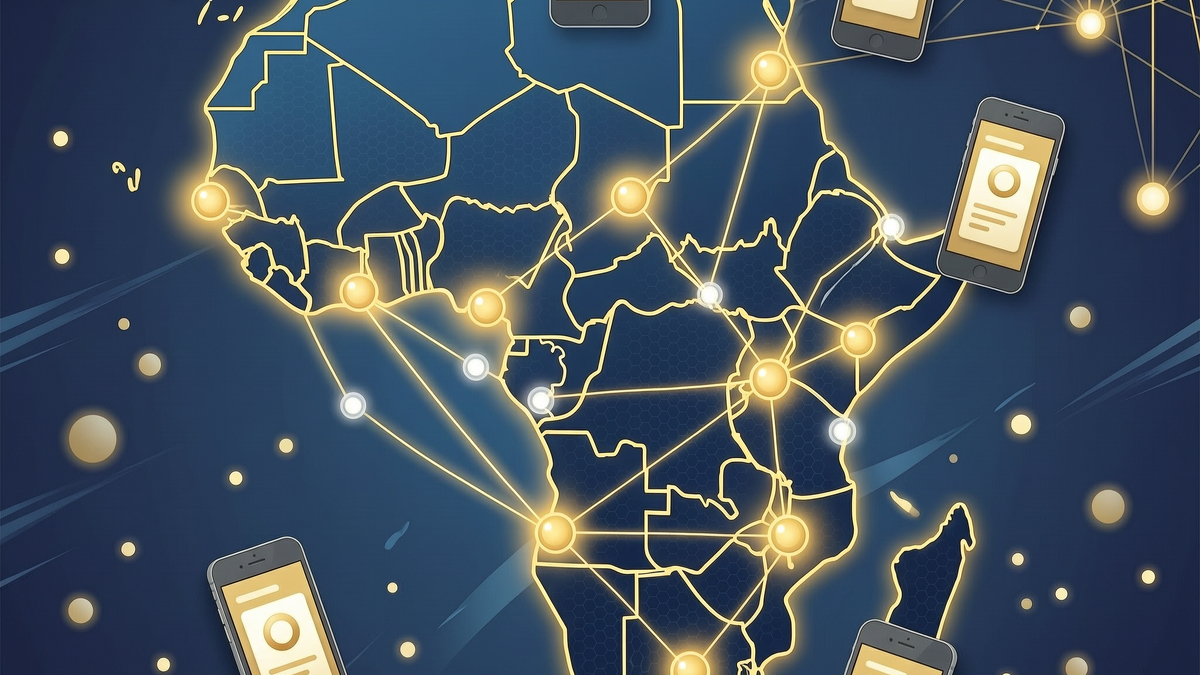
Sub-Saharan Africa counted 1.2 billion registered mobile money accounts in 2025, and 341 million of them were active in the previous 30 days. That is where many recipients now expect to be paid. Mobile money payouts stablecoin funding is one practical way to reach them without holding local currency in every market.
The model is simple. Your treasury holds USDC or EURC, funds a float balance on Yativo, and requests a local payout. A licensed local payout partner credits the recipient’s wallet in local currency.
This guide explains what mobile money is, how the rails behave, why funding them from abroad is hard, and how Yativo’s Mobile Money gateways work.
What Is Mobile Money?
Mobile money is a stored-value account attached to a phone number. Participants can move money between mobile wallets and bank accounts inside the region.
The scale is regional. Across Sub-Saharan Africa, mobile money moved US$1.4 trillion in transaction value in 2025, about 66% of global mobile money value. Globally, more than US$2 trillion flowed through wallets in 2025.
Adoption is deep in specific markets. Cameroon held 65.1% of all CEMAC mobile money accounts in 2024, and ART counted 11.43 million active accounts there. In Ghana, active wallets reached 26.7 million by December 2025.
Who uses it? Contractors, field staff, freelancers, agents, drivers and family members receiving remittances.
What recipients actually hold
- A phone number registered to a wallet, which is the identifier that matters.
- A balance in local currency, spendable at agents or through merchant payments.
- Sometimes a linked bank account, since participants can move money between mobile wallets and bank accounts in some markets.
How Mobile Money Works
A payout is a credit to a mobile wallet. The identifier is a phone number, sometimes paired with a wallet provider name.
Identifiers and recipient details
You need the recipient’s full name, the phone number registered to the wallet, and the country. Collect these once before the first payment run.
Timing
On Yativo, the Mobile Money gateways listed below settle in under 30 minutes. Local rails are fast too: GhIPSS Instant Pay credits transfers in real time, 24/7, and PesaLink moves bank-to-bank payments instantly, 24/7.
What the recipient needs
A working phone and a registered wallet. That is it. The recipient never needs a crypto wallet and receives a normal local credit.
Why Funding Mobile Money Payouts from Abroad Is Hard
Prefunding is capital intensive. To pay wallets in several markets you must hold balances in each local currency, often with separate partners. Idle float ties up working capital and complicates forecasting.
FX exposure sits on your books. Between funding and payout, the local currency moves. Small treasury teams end up absorbing that variance or passing it to recipients.
Sending small amounts across borders costs an average of 6.36% of the amount sent, per the World Bank. That hurts when most transfers are small.
Coverage is fragmented. Each market has its own operators, identifiers and partner relationships. A single process rarely works across Kenya, Ghana, Senegal and Uganda without local help.
How Mobile Money Payouts with Stablecoin Funding Work on Yativo
You fund a float balance with USDC or fiat and a licensed local payout partner pays out on Mobile Money.
- Fund your float balance with USDC or fiat. Stablecoin funding keeps your treasury in a single unit of account instead of many local balances.
- Request a quote for the corridor and amount. You see the conversion before you commit.
- Submit the payout with recipient details. Yativo routes it to a licensed local payout partner.
- The partner credits the wallet in local currency. The Mobile Money gateways settle in under 30 minutes.
Yativo’s active gateways cover eight markets, each with its own gateway ID.
| Gateway | ID | Settlement |
| Mobile Money (CM), XAF, Cameroon | 1319 | Under 30 minutes |
| Mobile Money (GM), GMD, The Gambia | 1320 | Under 30 minutes |
| Mobile Money (GH), GHS, Ghana | 1321 | Under 30 minutes |
| Mobile Money (CI), XOF, Côte d’Ivoire | 1322 | Under 30 minutes |
| Mobile Money (KE), KES, Kenya | 1323 | Under 30 minutes |
| Mobile Money (RW), RWF, Rwanda | 1324 | Under 30 minutes |
| Mobile Money (SN), XOF, Senegal | 1325 | Under 30 minutes |
| Mobile Money (UG), UGX, Uganda | 1326 | Under 30 minutes |
These are the active gateways in Yativo’s catalog today. Always read the live list from the payout-methods endpoint before you route a payment.
Your recipient does not need a crypto wallet. They never see or touch stablecoins. On their side, the payment looks like a normal local transfer.
How to Send Mobile Money Payouts with Yativo
Option 1: Dashboard (for manual payouts)
- Fund your Yativo float balance with either a fiat or a stablecoin deposit, such as USDC.
- Go to Transfer in your Yativo dashboard.
- Select the float wallet you are paying with, for example USD, EUR, MXN or whichever balance you funded.
- Choose the customer you are paying on behalf of. This step is necessary for fintechs that run payouts on behalf of their customers.
- Choose Kenya as the destination and Mobile Money (KE) as the payout method.
- Enter the recipient details the payout form asks for, such as the wallet holder name and mobile number.
- Enter the amount in USD or KES.
- Review the quote: exchange rate, fees, delivery time and the exact KES amount your recipient receives.
- Confirm with your PIN and 2FA.
- Track the payout in real time and download the receipt for your records.
Option 2: API (for automated and bulk payouts)
Every endpoint below is in the Yativo API documentation. Production calls go to https://api.yativo.com/api/v1, and the sandbox runs at https://smtp.yativo.com/api/v1.
Authenticate every request with the X-Api-Key and X-Api-Secret headers. Each key only works from the server IPs listed on it. These keys replaced bearer tokens, as covered in our October update. Every POST also needs a unique Idempotency-Key header.
Step 1. Generate a USDC deposit address on Solana to fund your balance:
POST https://api.yativo.com/api/v1/crypto/create-wallet
X-Api-Key: $YATIVO_API_KEY
X-Api-Secret: $YATIVO_API_SECRET
Idempotency-Key: 19a7c2bd-91ee-5fed-b3ab-0ba8eaaa9928
Content-Type: application/json

{
  "currency": "USDC_SOL"
}
Step 2. List the payout methods available for Kenya:
curl "https://api.yativo.com/api/v1/payment-methods/payout?country=KEN" \
  -H "X-Api-Key: $YATIVO_API_KEY" \
  -H "X-Api-Secret: $YATIVO_API_SECRET" \
  -H "Accept: application/json"
In this example, Mobile Money (KE) carries gateway ID 1323. Always read the ID from the live response instead of hardcoding it.
Step 3. Fetch the required fields for that gateway:
GET https://api.yativo.com/api/v1/beneficiary/form/show/1323
X-Api-Key: $YATIVO_API_KEY
X-Api-Secret: $YATIVO_API_SECRET
The response lists every required field and its accepted values. Build your payment_data object from it. For field details, see API documentation.
Step 4. Create the beneficiary. Replace the placeholder with the fields the form returned:
POST https://api.yativo.com/api/v1/beneficiaries/payment-methods/
X-Api-Key: $YATIVO_API_KEY
X-Api-Secret: $YATIVO_API_SECRET
Idempotency-Key: 3f479028-95a6-5881-9d13-0afb6742f826
Content-Type: application/json

{
  "gateway_id": 1323,
  "nickname": "Nairobi field agent",
  "currency": "KES",
  "customer_id": "e8caa491-57b6-4c39-9e3a-d2c97e47fbf0",
  "payment_data": {
    "{field_from_form}": "{value}"
  }
}
Step 5. Lock your KES rate. Quotes hold for 5 minutes:
POST https://api.yativo.com/api/v1/exchange-rate
X-Api-Key: $YATIVO_API_KEY
X-Api-Secret: $YATIVO_API_SECRET
Idempotency-Key: b0541af3-8040-50e6-a830-75c51fcaca24
Content-Type: application/json

{
  "from_currency": "USD",
  "to_currency": "KES",
  "method_id": 1323,
  "method_type": "payout",
  "amount": 300
}
Step 6. Initiate the payout from your balance:
POST https://api.yativo.com/api/v1/wallet/payout
X-Api-Key: $YATIVO_API_KEY
X-Api-Secret: $YATIVO_API_SECRET
Idempotency-Key: 9650d186-c368-53ab-93d4-06f87233f280
Content-Type: application/json

{
  "debit_wallet": "USD",
  "amount": 300,
  "payment_method_id": 48282,
  "customer_id": "e8caa491-57b6-4c39-9e3a-d2c97e47fbf0",
  "quote_id": "4a72ecf8-6c8a-4e38-9971-8aabe9f785ed"
}
Use the id from the beneficiary response as payment_method_id. For bulk runs, repeat the call per beneficiary, as described on our payouts page.
Mobile Money vs Other Payout Options
| Option | Speed | Recipient details | Best for |
| Mobile Money | Under 30 minutes on Yativo gateways | Name and registered phone number | Contractors, field staff and wallet-first recipients |
| Bank transfer | Depends on market | Account details | Larger invoices and recipients with business accounts |
| Card payout | Depends on issuer | Card details | One-off refunds where no wallet or bank is available |
| Cash pickup | Depends on agent | Name and ID at the counter | Recipients without a wallet or bank account |
Mobile money usually wins on reach. Bank transfer wins on ticket size. Card and cash pickup are fallbacks.
Best Practices for Mobile Money Payouts
Validate phone numbers before you send. A wrong number credits a stranger. Confirm the number is registered to a wallet before the first payment.
Keep payout batches small and frequent. Smaller runs limit exposure and make reconciliation easier. They also match how recipients actually use wallets.
Track active accounts, not registered ones. GSMA notes that almost 75% of mobile money accounts are inactive monthly. A registered number is not proof of an active wallet.
Match the corridor to the right rail. Read the country guides before you build, including Kenya mobile money payouts and Ghana mobile money payouts. The same applies to Uganda mobile money payouts and Senegal mobile money payouts.
Respect catalog limits. Each gateway has minimum and maximum payout amounts. Build validation into your payout request so failed submissions do not reach the partner.
Reconcile daily. Match each payout reference to the partner confirmation and your float movement. Daily reconciliation catches stuck transfers before recipients complain.
Frequently Asked Questions
How fast do Mobile Money payouts settle on Yativo?
The eight active Mobile Money gateways settle in under 30 minutes. GhIPSS Instant Pay credits transfers in real time, 24/7.
What recipient details do I need for a mobile money payout?
You need the recipient’s full name, the phone number registered to the wallet, and the country.
Which African markets does Yativo cover for Mobile Money payouts?
Yativo has active gateways for Cameroon, The Gambia, Ghana, Côte d’Ivoire, Kenya, Rwanda, Senegal and Uganda. Each gateway has its own ID and local currency.
Does my recipient need a crypto wallet?
No. Your recipient gets a normal local credit in their usual account or wallet. They never touch stablecoins, and the payment looks like any other domestic transfer.
Is paying out this way legal and compliant?
Yes, when it runs through regulated infrastructure. Yativo is registered with FinCEN as a Money Services Business, registration number 31000270723339. A licensed local payout partner handles the local leg. Your own tax and reporting duties still apply, so confirm them with your advisor.
How long does a quote last?
Quotes from the exchange-rate endpoint hold for 5 minutes. You see the rate, the fees and the exact amount your recipient gets before you confirm.
Start Sending Mobile Money Payouts with Yativo
Fund one float and let a licensed local payout partner deliver to wallets in eight African markets. Your recipients get a normal local credit, in under 30 minutes on the listed gateways. Book a demo to set up your first payout, or contact sales if you already know your monthly volume.
Sources
- GSMA: The State of the Industry Report on Mobile Money 2026
- GSMA: Mobile money accounted for $2 trillion in transactions in 2025
- World Bank: Remittance Prices Worldwide
- investiraucameroun.com: 65.1% of all CEMAC mobile money accounts in 2024
- businessincameroon.com: 11.43 million active accounts there
- myjoyonline.com: 26.7 million by December 2025
- beac.int: Move money between mobile wallets and bank accounts
- mail.ghipss.net: Credits transfers in real time, 24/7
- pesalink.co.ke: Instantly, 24/7