
Stablecoins are not crypto. They are infrastructure.
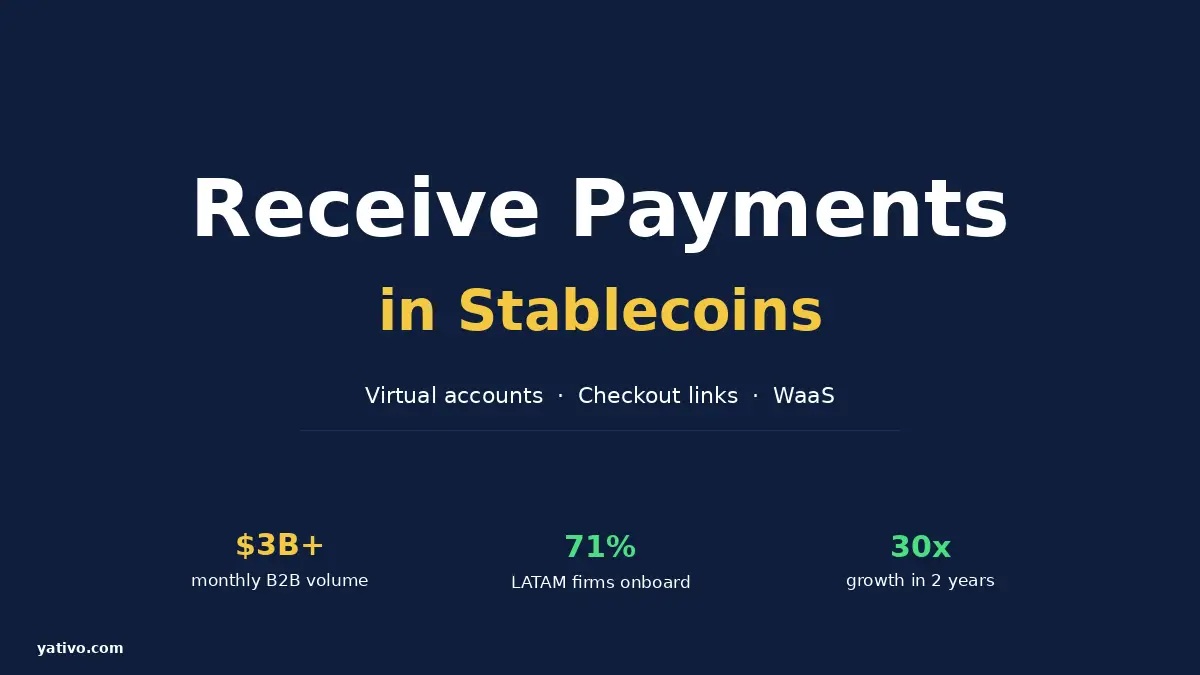
The distinction matters for businesses. A stablecoin is a digital dollar. It holds its value, settles in minutes, moves 24/7, and does not require a correspondent bank chain to cross a border. B2B stablecoin payment volumes surged from under $100 million per month in early 2023 to over $3 billion by early 2025, a 30-fold increase in two years.
77% of organizations surveyed by EY in June 2025 cited paying suppliers across borders as their top stablecoin use case. 71% of Latin American firms are already using stablecoins for cross-border payments. The shift is happening now, and the businesses adopting stablecoin payment infrastructure today are building a structural cost and speed advantage over those still running everything through SWIFT.
Yativo supports three distinct mechanisms for receiving international payments in stablecoins. This guide explains how each one works, who it is suited for, and how to implement it via dashboard or API.
Why Receive Payments in Stablecoins
- Speed: Stablecoin settlement happens in minutes, 24 hours a day, 7 days a week. No correspondent bank cut-off times. No waiting for Monday morning when your supplier in Asia needs payment on a Friday afternoon.
- Cost: Among organizations already using stablecoins, 41% reported cost savings of at least 10%, primarily in B2B cross-border payments. There are no correspondent bank fees, no nostro account pre-funding costs, and no opaque mid-transfer deductions.
- Transparency: Every stablecoin transaction is traceable on-chain. You know exactly what was sent, when it arrived, and what the cost was before you confirm.
- USD stability: USDC and USDT are pegged 1:1 to the US dollar. You collect in USD value without needing a US bank account, and without exposure to local currency volatility between invoice and payment.
- Flexibility: Once you hold USDC or USDT, you can withdraw to an external wallet, convert to local currency for a LATAM bank payout, or use it directly to fund supplier payments in China, India, or anywhere else Yativo supports.
Three Ways to Receive Stablecoin Payments via Yativo
1. Virtual Accounts
Virtual accounts let you issue a unique local payment account to each of your customers. The customer pays in their local fiat currency via their preferred local rail (ACH, SPEI, PIX, bank transfer, etc.). Yativo settles you in stablecoins (USDC or USDT).
From the customer’s perspective, this is a completely normal payment. They see a bank account number and routing number, or local payment details, and pay exactly as they normally would. The stablecoin conversion happens on your side.
Best for: Businesses that want to accept payments from clients across multiple countries, each using their own local payment method, while settling centrally in stablecoins.
Use case example: A SaaS company in Chile issues a unique USD virtual account to a US client and a unique SPEI account to a Mexican client. Both clients pay in their local way. The SaaS company settles in USDC for both.
2. Checkout Links
Checkout links are the fastest way to start collecting. You generate a unique payment link for each order or invoice, then send or redirect your customer to the checkout page. The customer selects their payment method and pays in fiat. Yativo settles you in stablecoins.
No integration required to get started. Generate a link from your dashboard, share it with your customer, and the settlement is automatic.
Best for: Businesses sending invoices, freelancers, service businesses, and anyone who wants to start accepting stablecoin-settled payments immediately without API integration.
Use case example: A consulting firm in Colombia generates a checkout link for a $5,000 project invoice. The US client clicks the link, pays via ACH. The firm receives USDC in their Yativo wallet within minutes.
3. Wallet-as-a-Service (WaaS)
WaaS is the most powerful collection mechanism for platforms and fintechs. You use the Yativo API to generate unique stablecoin wallet addresses for each of your customers. Customers pay directly in stablecoins to their assigned address. You can settle in stablecoins or convert to local fiat currency.
This is the only mechanism where the customer pays in stablecoins directly, rather than in fiat. It is designed for crypto-native customers, platforms serving stablecoin users, and fintechs building stablecoin-native products.
Best for: Platforms, marketplaces, neobanks, and fintechs that want to issue dedicated stablecoin wallets to their customers and manage collections programmatically at scale.
Use case example: A cross-border marketplace issues a unique USDC wallet address to each seller. Buyers pay in USDC directly to each seller’s address. The marketplace settles sellers in USDC or converts to local fiat for payout.
Choosing the Right Collection Method
| Virtual Accounts | Checkout Links | WaaS | |
| Customer pays in | Fiat | Fiat | Stablecoins |
| You settle in | USDC / USDT | USDC / USDT | USDC / USDT or fiat |
| Integration needed | API or dashboard | Dashboard (no code) | API required |
| Best for | Multi-country B2B | Invoices, freelancers | Platforms, fintechs |
| Customer crypto knowledge | Not required | Not required | Required |
How to Get Started
Option 1: Dashboard (Checkout Links, no code required)
- Go to Checkouts in your Yativo dashboard
- Click Create Payment Link
- Set the amount in USD or local currency
- Select the collection methods to offer your customer
- Copy the link and send to your customer via email or invoice
- Customer pays in their local fiat currency
- USDC or USDT is credited to your Yativo wallet automatically
- Download receipt for accounting and compliance
Option 2: API (Virtual Accounts and WaaS)
Full API documentation is available at Yativo API Documentation.
Create a virtual account for a customer (USD example):
POST /api/v1/business/virtual-account/create

{

  "currency": "USDBASE",

  "customer_id": "uuid"

}
List all virtual accounts:
GET /api/v1/business/virtual-accountGet transaction history for an account:
POST /business/virtual-account/history/{accountNumber}For WaaS wallet address generation, use the Yativo wallet creation endpoints to issue unique stablecoin addresses per customer. Contact the Yativo team for WaaS-specific API documentation and onboarding.
What You Can Do Once You Receive Stablecoins
- Withdraw to your external wallet: Send USDC or USDT from your Yativo wallet to any external wallet address at any time.
- Payout to your LATAM bank account in local currency: Use the standard Yativo payout flow to convert USDC to CLP, MXN, BRL, COP, or another supported currency and receive it in your local bank account.
- Fund supplier payments.:Use your stablecoin balance to pay Chinese suppliers via local bank transfer or Alipay, Indian suppliers via UPI or IMPS, or any other corridor Yativo supports.
- Hold as USD-denominated treasury: USDC and USDT maintain their value in USD terms. Holding stablecoins lets you preserve USD value without needing a US bank account, useful in high-inflation markets.
Frequently Asked Questions
Does my customer need a crypto wallet to pay me?
For virtual accounts and checkout links, no. Your customer pays in their local fiat currency via their normal payment method. The stablecoin conversion happens on your side. For WaaS, your customer does pay in stablecoins directly, which requires a crypto wallet.
Which stablecoins does Yativo support?
Yativo supports USDC, USDT, PYUSD and USDG. Both are USD-pegged stablecoins backed 1:1 by US dollar reserves.
How quickly do I receive the stablecoin settlement?
Settlement is typically fast, ranging from near-instant for stablecoin-to-stablecoin transfers to within minutes for fiat-to-stablecoin conversion depending on the payment rail used.
Is this compliant?
Yes. Yativo is registered with FinCEN as a Money Services Business. All collections flow through licensed intermediaries. KYC/KYB is required before accessing collection features.
Can I issue virtual accounts to my own customers?
Yes. Virtual accounts can be created for your own business or issued to each of your customers individually via the API, giving each customer their own dedicated account number.
What currencies can I offer my customers for fiat payment?
Depends on the collection method and corridor. Yativo supports USD (via ACH, Fedwire, SWIFT), MXN (SPEI), BRL (PIX), and other local currencies. Check the Yativo API for the full list of supported collection currencies per country.
Start Receiving in Stablecoins Today
B2B stablecoin payment volumes have grown 30x in two years. The businesses building stablecoin collection infrastructure now are the ones that will have the cost and speed advantage in the next two years.
Yativo gives you three ways to receive international payments in stablecoins: virtual accounts for multi-country B2B collection, checkout links for zero-integration invoicing, and WaaS for platforms building stablecoin-native products.
Try payment links to receive your first stablecoin-settled payment today.