
Global trade is evolving faster than ever. Importers and exporters no longer want to wait days for international settlements, deal with hidden intermediary fees, or struggle with limited banking access across multiple countries. Businesses today need payment infrastructure that moves as fast as global commerce itself.
That is where multi-currency virtual accounts come in.
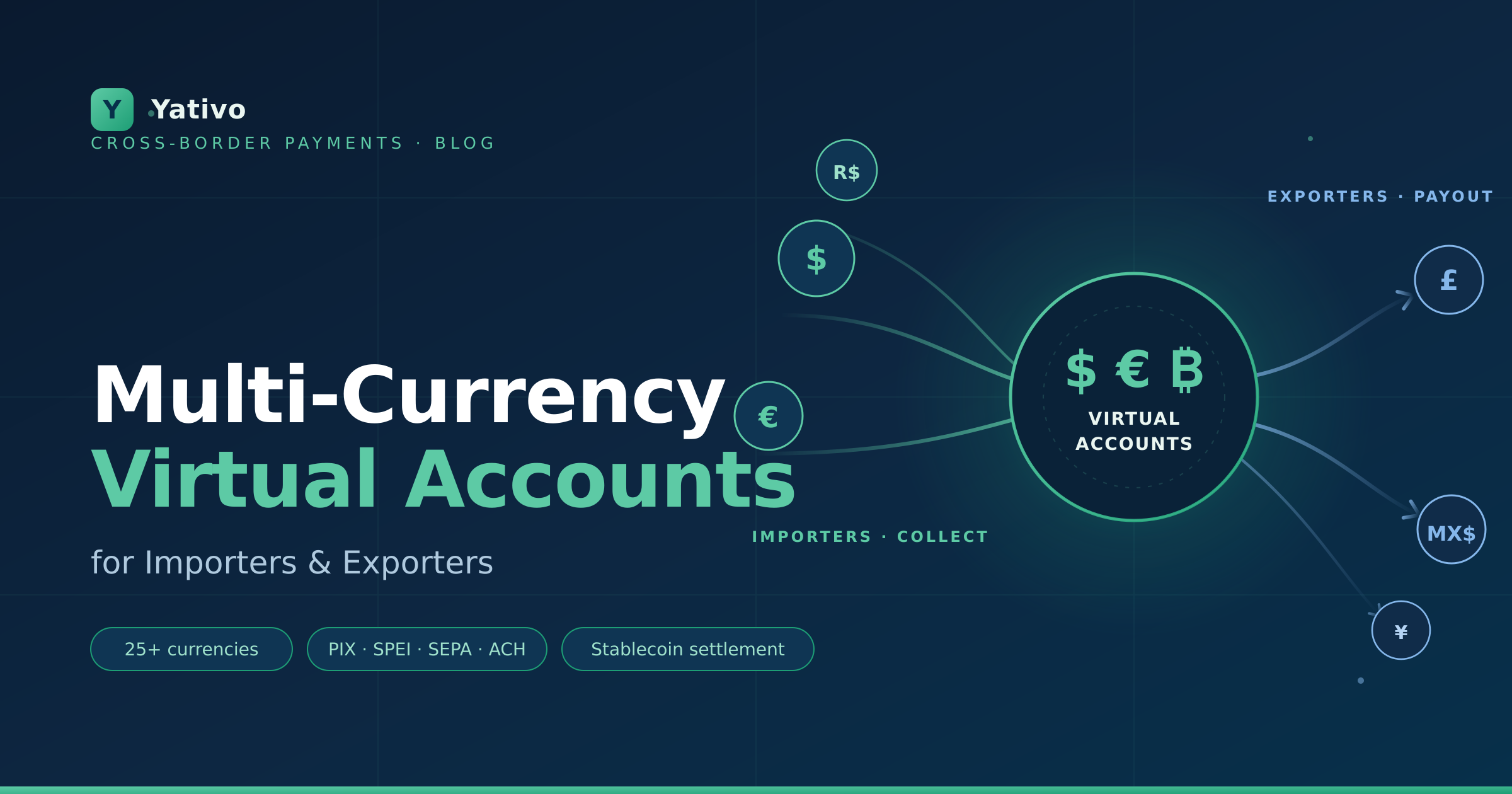
With Yativo, importers and exporters can collect, hold, convert, and send funds across multiple currencies using a single modern financial infrastructure designed for international business.
What Are Multi-Currency Virtual Accounts?
Multi-currency virtual accounts are digital business accounts that allow companies to receive and manage payments in different currencies without opening physical bank accounts in every country.
Instead of maintaining several banking relationships across jurisdictions, businesses can operate through a unified infrastructure that supports collections and payouts globally.
For example, an exporter in Chile can:
- Receive payments in USD from the United States
- Collect BRL from Brazil
- Accept EUR from Europe
- Settle suppliers in CNY or HKD
- Convert balances into stablecoins or local currencies
—all from one platform.
This simplifies treasury management and reduces operational complexity for businesses trading internationally.
Why Importers and Exporters Need Multi-Currency Accounts
Traditional international banking systems were not built for the speed of modern commerce. Many businesses still face challenges such as:
- Slow settlement times
- High SWIFT transfer fees
- Poor exchange rates
- Delayed supplier payments
- Limited visibility into international transactions
- Difficulties opening foreign bank accounts
- Compliance bottlenecks
These issues become even more problematic for businesses operating across Latin America, Asia, Africa, Europe, and North America.
Multi-currency virtual accounts solve these problems by enabling businesses to receive and manage international payments locally while maintaining centralized control.
How Yativo Helps Importers and Exporters
Yativo provides modern financial infrastructure for global businesses that need seamless cross-border payment capabilities.
Using Yativo’s multi-currency virtual accounts, businesses can:
Receive Local Payments Globally
Importers and exporters can receive funds from customers in multiple countries using local payment methods and local currency rails.
This improves customer trust and increases payment conversion rates because clients can pay in familiar currencies and methods.
Examples include:
- PIX in Brazil
- Local bank transfers in Latin America
- USD collections
- Stablecoin settlements
- International wire support
Faster Supplier Payments
Businesses working with overseas manufacturers and suppliers often lose valuable time waiting for international transfers to clear.
Yativo enables faster settlements through optimized payment rails and stablecoin infrastructure, helping businesses:
- Pay suppliers quickly
- Reduce settlement delays
- Improve supply chain relationships
- Access better foreign exchange opportunities
Better Foreign Exchange Management
Currency volatility can significantly impact importer and exporter profitability.
With multi-currency infrastructure, businesses can:
- Hold balances in multiple currencies
- Convert currencies strategically
- Reduce unnecessary conversion losses
- Access more transparent exchange pricing
This is particularly valuable for businesses importing inventory from Asia or exporting products to multiple international markets.
Stablecoin-Powered Global Settlements
Modern trade is increasingly adopting stablecoins because they provide:
- Faster international settlements
- Lower transaction costs
- 24/7 transfer availability
- Reduced dependency on legacy banking systems
Yativo integrates stablecoin capabilities into its infrastructure, allowing businesses to bridge traditional finance and digital asset settlements seamlessly.
For example:
- A business can collect CLP in Chile
- Convert funds into USDC
- Settle a supplier in Asia
- Complete the process significantly faster than traditional banking rails
Operational Efficiency for Growing Businesses
Managing multiple banks, currencies, and international payment providers creates operational overhead.
Yativo centralizes:
- Payment collections
- Currency conversion
- Payout management
- Transaction tracking
- Virtual accounts
- Treasury visibility
This allows finance teams to spend less time handling banking logistics and more time growing the business.
Use Cases for Importers and Exporters
Importers
Businesses importing goods internationally can:
- Pay overseas suppliers faster
- Reduce SWIFT banking costs
- Hold foreign currencies strategically
- Access efficient settlement infrastructure
Exporters
Businesses exporting products or services can:
- Receive international payments locally
- Offer customers localized payment experiences
- Improve cash flow timing
- Minimize FX losses
Marketplaces and Trading Platforms
International B2B marketplaces can use Yativo to:
- Collect payments globally
- Distribute payouts to vendors
- Support multiple currencies
- Simplify cross-border settlements
Why Businesses Are Moving Away From Traditional Banking Limitations
Global commerce is becoming digital-first. Businesses want:
- Real-time settlements
- Better transparency
- Lower transaction costs
- Global accessibility
- Flexible payment infrastructure
Traditional banking systems alone often cannot meet these expectations efficiently.
That is why modern businesses are increasingly adopting fintech infrastructure providers like Yativo to manage international trade operations.
The Future of International Trade Payments
Cross-border payments are entering a new era powered by:
- Stablecoins
- Embedded finance
- Virtual accounts
- Real-time payment systems
- API-driven financial infrastructure
Importers and exporters that modernize their payment infrastructure early will gain operational advantages, improve supplier relationships, and scale internationally more efficiently.
Multi-currency virtual accounts are no longer just a convenience — they are becoming essential infrastructure for global business.
Final Thoughts
International trade should not be slowed down by outdated financial systems.
With multi-currency virtual accounts from Yativo, importers and exporters can simplify global collections, improve payouts, manage multiple currencies efficiently, and scale their businesses internationally with greater speed and flexibility.
As global commerce continues to evolve, businesses that adopt modern payment infrastructure will be better positioned to compete in the international marketplace.