
Your supplier in Santa Cruz quoted you in bolivianos last week. Since then, the official dollar rate has moved again, and your wire is still somewhere between correspondent banks.
Local bank transfer payouts to Bolivia with stablecoin settlement fix both problems. You fund in USDC or USD, lock a quote, and your recipient gets bolivianos (BOB) in their own Bolivian bank account.
The demand is real. Bolivia imported US$10.03 billion in goods in 2025 and exported US$9.70 billion, according to INE figures reported by Unitel. Each of those trade relationships needs suppliers, agents and contractors paid on time.
This guide covers why Bolivia payouts break, how the stablecoin-funded flow works, and which recipient details you need. It then walks through your first BOB payout by dashboard and by API.
Why Paying Out in Bolivia Is Harder Than It Should Be
Bolivia’s domestic payment system is fast and widely used. The friction sits at the border, where your foreign payment meets a newly floating currency and scarce dollars.
The boliviano no longer has a fixed rate. Until June 2026, the official selling rate was fixed at Bs 6.96 per dollar. On June 26, 2026, the central bank approved new rules for a flexible exchange rate regime, set daily from banks’ dollar purchases.
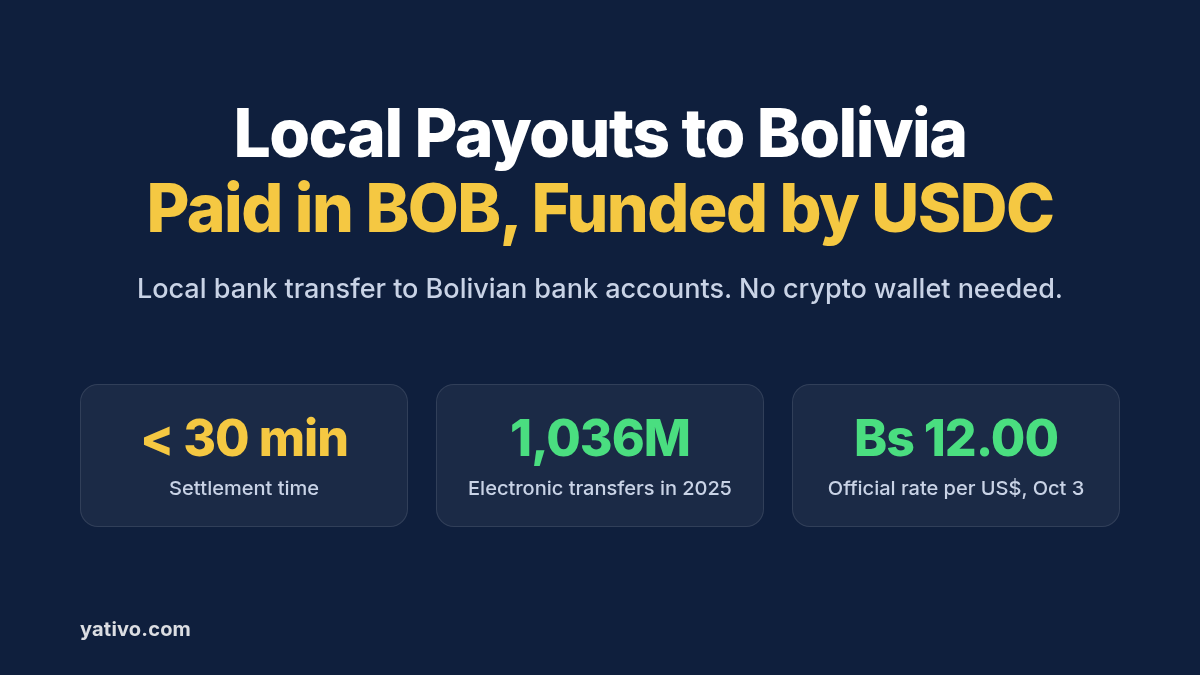
The rate moves fast. In September 2026 alone, the official rate ranged from Bs 9.83 to Bs 12.64 per dollar, according to Banco Central de Bolivia (BCB) data. On October 3, 2026, it stood at Bs 12.00. A quote that is not firm before you send can cost you or your recipient.
Prices are still rising. Consumer prices rose 5.02% in the 12 months to August 2026, according to INE, Bolivia’s statistics office. A payout that lands days late is worth less on arrival.
Small cross-border transfers are expensive. Sending small amounts abroad costs an average of 6.36% of the amount sent, according to the World Bank. On a US$40,000 monthly payroll, that average would cost you US$2,544 every month. We break down more of these costs in the hidden costs of international payments.
Local Bank Transfer Payouts to Bolivia with a Stablecoin Layer: How It Works
Yativo is payment infrastructure, not a bank. We use stablecoins as the settlement layer between your balance and Bolivia. A licensed local payout partner then delivers the bolivianos on the ground.
- You fund your Yativo float balance with a fiat or stablecoin deposit, such as USDC.
- Yativo converts the payout value to USDC and settles it on-chain.
- A licensed local payout partner in Bolivia receives the stablecoin settlement.
- The partner converts USDC to BOB and sends a domestic bank transfer to the recipient’s account.
- Your recipient receives bolivianos in their normal bank account.
Your recipient does not need a crypto wallet. They never see or touch stablecoins. On their side, the payment looks like any domestic transfer from a local sender.
Delivery runs on domestic rails. Bolivian banks processed 1,036 million electronic funds transfers worth Bs 1.1 trillion in 2025, according to the BCB’s payment system report. That volume grew 97% in a single year.
Stablecoins are also gaining ground. The BCB lifted its ban on buying and selling virtual assets through electronic payment channels in June 2024. Chainalysis puts Bolivia’s crypto transaction volume at US$14.8 billion for July 2022 to June 2025. For more on the settlement layer, read how to receive international payments in stablecoins.
Supported Payout Rails for Bolivia
Yativo launched local payout rails for BOB in September 2026. The active BOB methods are Bank Transfer and QR (BOL). This guide covers Bank Transfer, which pays bolivianos into an account at a Bolivian bank.
Bank Transfer (BOL)
Bolivian interbank transfers run through the ACH clearing house operated by ACCL, which settles through the BCB, per the BCB payment system report.
Required details: the fields returned by the Bolivia payout form, typically the holder’s legal name, CI or NIT, bank and account number. See the API section below for how to fetch them.
Settlement time: payouts via Bank Transfer (BOL) settle in under 30 minutes.
Local clearing: Bolivia’s ACH runs every day. It operates three cycles on weekdays and a single cycle on weekends and holidays, as Banco Ganadero explains.
Best for: suppliers, agencies, contractors and payroll recipients with a Bolivian bank account.
QR (BOL)
Yativo also pays out in bolivianos through QR (BOL), gateway ID 1377, which settles in under 30 minutes too. We cover it in our guide to QR payouts in Bolivia.
USD alternatives
If your recipient wants dollars rather than bolivianos, Bank Transfer (BOL) is the wrong tool, because it delivers BOB. Our Bolivia methods list also includes SWIFT, which pays USD. Check the live list before you build, since availability depends on your account.
Recipient Details to Collect Before Your First BOB Payout
The Bolivia payout form in our API is the authoritative field list. Collect the details below during onboarding so you can fill it without a round of emails.
- Holder type: individual or company.
- Legal name: full name as it appears on the CI, or the registered company name.
- CI or NIT: the identity card number for individuals, or the tax ID (NIT) for companies.
- Bank: the name of the recipient’s Bolivian bank.
- Account number: the full number, copied from a bank statement or app.
- Account currency: confirm the account holds bolivianos, since Bolivian banks also offer USD accounts.
- Email and address: for the beneficiary record.
- Payment purpose: for example supplier payment, services or payroll.
Double-check the account number. Banks such as Banco FIE warn that only the beneficiary’s account number is validated on interbank transfers.
How to Send a BOB Payout via Yativo
Option 1: Dashboard (for manual payouts)
- Fund your Yativo float balance with either a fiat or a stablecoin deposit.
- Go to Transfer in your Yativo dashboard.
- Select the float wallet you are paying with, for example USD, EUR, MXN or whichever balance you funded.
- Choose the customer you are paying on behalf of. This step is necessary for fintechs that run payouts on behalf of their customers.
- Choose Bolivia as the destination country and the Bank Transfer (BOL) payout method.
- Enter the recipient details the Bolivia payout form asks for, such as the holder’s legal name, CI or NIT, bank and account number.
- Enter the amount in USD or BOB.
- Review the quote: exchange rate, fees, delivery time and the exact BOB amount your recipient receives.
- Confirm with your PIN and 2FA.
- Track the payout in real time and download the receipt for your records.
Option 2: API (for automated and bulk payouts)
Every endpoint below is in the Yativo API documentation. Production calls go to https://api.yativo.com/api/v1, and the sandbox runs at https://smtp.yativo.com/api/v1.
Authenticate every request with the X-Api-Key and X-Api-Secret headers. Each key only works from the server IPs listed on it. Login tokens stop working from servers on October 15, 2026, as covered in our October update. Every POST request also needs a unique Idempotency-Key header.
Step 1. Generate a USDC funding address on Solana to top up your USD balance:
POST https://api.yativo.com/api/v1/crypto/create-wallet
X-Api-Key: $YATIVO_API_KEY
X-Api-Secret: $YATIVO_API_SECRET
Idempotency-Key: 5d2e8f1a-7b3c-4e9d-a1f2-3b4c5d6e7f80
Content-Type: application/json

{
  "currency": "USDC_SOL"
}
Step 2. List the payout methods available for Bolivia:
curl "https://api.yativo.com/api/v1/payment-methods/payout?country=BOL" \
  -H "X-Api-Key: $YATIVO_API_KEY" \
  -H "X-Api-Secret: $YATIVO_API_SECRET" \
  -H "Accept: application/json"
The response can include two BOB bank transfer methods: Bank Transfer (BOL), gateway ID 1376, and Bank Transfer, gateway ID 496. Use the one the endpoint returns for your account. The examples below use 1376.
Step 3. Fetch the required fields for that gateway:
GET https://api.yativo.com/api/v1/beneficiary/form/show/1376
X-Api-Key: $YATIVO_API_KEY
X-Api-Secret: $YATIVO_API_SECRET
The response lists every required field and the accepted values for each one. Build your payment_data object from it. For field details, see API documentation.
Step 4. Create the beneficiary. Replace the placeholder with the fields the form returned:
POST https://api.yativo.com/api/v1/beneficiaries/payment-methods/
X-Api-Key: $YATIVO_API_KEY
X-Api-Secret: $YATIVO_API_SECRET
Idempotency-Key: 1c9e4b7a-2d5f-4a8c-9e1b-6f7a8b9c0d1e
Content-Type: application/json

{
  "gateway_id": 1376,
  "nickname": "Importadora Andina SRL",
  "currency": "BOB",
  "customer_id": "e8caa491-57b6-4c39-9e3a-d2c97e47fbf0",
  "payment_data": {
    "{field_from_form}": "{value}"
  }
}
Step 5. Optionally, lock your rate. Quotes hold for 5 minutes, which matters with a floating boliviano:
POST https://api.yativo.com/api/v1/exchange-rate
X-Api-Key: $YATIVO_API_KEY
X-Api-Secret: $YATIVO_API_SECRET
Idempotency-Key: 8b7a6c5d-4e3f-4a2b-9c1d-0e9f8a7b6c5d
Content-Type: application/json

{
  "from_currency": "USD",
  "to_currency": "BOB",
  "method_id": 1376,
  "method_type": "payout",
  "amount": 3000
}
Step 6. Initiate the payout from your USD balance:
POST https://api.yativo.com/api/v1/wallet/payout
X-Api-Key: $YATIVO_API_KEY
X-Api-Secret: $YATIVO_API_SECRET
Idempotency-Key: 2f3a4b5c-6d7e-4f8a-9b0c-1d2e3f4a5b6c
Content-Type: application/json

{
  "debit_wallet": "USD",
  "amount": 3000,
  "payment_method_id": 4822,
  "customer_id": "e8caa491-57b6-4c39-9e3a-d2c97e47fbf0",
  "quote_id": "4a72ecf8-6c8a-4e38-9971-8aabe9f785ed"
}
Use the id from the beneficiary response as payment_method_id. Leave out quote_id if you did not lock a rate. For bulk runs, repeat the call per beneficiary, as described on our payouts page.
Which Bolivia Payout Option Should You Use?
| Local bank transfer (BOB) via Yativo | International wire (SWIFT) | |
| Funding | USDC, USD or another float balance | USD from your bank |
| Delivery speed | Under 30 minutes | Depends on correspondent banks |
| Exchange rate | Locked in your quote | Depends on the banks that convert it |
| Required details | Form fields for gateway 1376 or 496 | SWIFT code, account number, bank address |
| Currency received | BOB | USD or BOB, depending on the account |
| Best for | Suppliers, contractors, payroll | Large one-off transfers |
Best Practices for Bolivia Payouts
Lock the rate on large payouts. The official rate is now recalculated every business day. Lock a 5-minute quote for payroll runs and large invoices, so the BOB amount matches what you promised.
Quote invoices in a stable reference. Agree with suppliers whether invoices are fixed in USD or BOB. With a floating rate, that choice decides who carries the exchange risk.
Verify the account number and ID before paying. Bolivian banks check only the account number. Match it with the holder’s name and CI or NIT on your first payout.
Read gateway IDs at runtime. Yativo sunset several rails on September 2, 2026. Pull IDs from the payout methods endpoint so your integration survives future changes.
Save each beneficiary once. Reusable payment methods remove re-entry errors. Recurring payouts then become a single API call.
Run one playbook across LATAM. The same flow works in other markets. See our guide to local payouts to Argentina via bank transfer and our breakdown of LATAM payout rails.
Frequently Asked Questions
Does my recipient in Bolivia need a crypto wallet?
No. Your recipient gets bolivianos in their normal Bolivian bank account. They never interact with stablecoins, and the payment arrives as a domestic transfer.
Is it legal and compliant to pay Bolivian recipients this way?
Yes, when the payout runs through regulated infrastructure. Yativo is registered with FinCEN as a Money Services Business, registration number 31000270723339. A licensed local payout partner makes the domestic transfer, so your recipient sees a normal local payment. Your own tax and reporting duties still apply, so confirm them with your compliance advisor.
How long does a BOB payout take?
Payouts via Bank Transfer (BOL) settle in under 30 minutes. The bolivianos arrive in your recipient’s bank account as a normal domestic transfer.
Which exchange rate applies to my payout?
The rate in your Yativo quote, which you see and accept before you send. Bolivia’s official rate now floats and is published daily by the central bank, so lock a quote for large payouts.
Can my recipient receive US dollars instead of bolivianos?
Not through this rail, which delivers BOB. Check GET /payment-methods/payout?country=BOL for any USD methods enabled on your account, or ask your account executive.
What happens if the account details are wrong?
Bolivian banks validate only the beneficiary’s account number on interbank transfers, so a wrong but valid number can reach the wrong person. Confirm the account number, holder name and CI or NIT with your recipient before the first payout.
Start Paying Out in Bolivia in Bolivianos
Bolivia’s official rate swung between Bs 9.83 and Bs 12.64 per dollar in September 2026 alone. A firm quote and fast domestic delivery protect both you and your recipient. Yativo lets you fund in USDC or USD and deliver BOB to Bolivian bank accounts in under 30 minutes, through a licensed local payout partner. Book a demo to set up your first Bolivia payout.
Sources
- Banco Central de Bolivia (BCB): Cotizaciones oficiales del boliviano con relación al dólar estadounidense, año 2026
- BCB: Tabla de cotizaciones del 3, 4 y 5 de octubre de 2026
- Red Uno de Bolivia: ¡Adiós al 6.96! BCB aprueba reglamento para definir el tipo de cambio oficial bajo régimen flexible
- Instituto Nacional de Estadística (INE): El IPC presentó una variación positiva de 1,10% en agosto de 2026
- Unitel: Bolivia importó más de lo que exportó y cerró 2025 con déficit comercial de $us 327 millones, según el INE
- BCB: Informe de Vigilancia del Sistema de Pagos 2025
- Banco Ganadero: Interbancarias ACH
- Banco FIE: Transferencias Interbancarias ACH
- BCB: Comunicado CP35/2024: el BCB actualiza normativa en torno a los activos virtuales
- Chainalysis: Latin America Emerges as a Crypto Powerhouse Amid Volatile Growth
- World Bank: Remittance Prices Worldwide
- Yativo: Yativo API Documentation
- Yativo: New Virtual Accounts, Checkout Links, and Local Payout Rails Now Live
- Yativo: Safer API access, three new virtual accounts and new payment links
- Yativo: Important Update: Streamlining Our Rail Network Effective September 2, 2026