
Your apparel supplier in Guatemala City needs quetzales by Friday to pay its workers. Your dollar wire is still waiting on a correspondent bank, and nobody can tell you when it will land.
Local bank transfer payouts to Guatemala with stablecoin settlement fix that gap. You fund in USDC or USD, lock a quote, and your recipient gets quetzales (GTQ) in their own bank account in under 30 minutes.
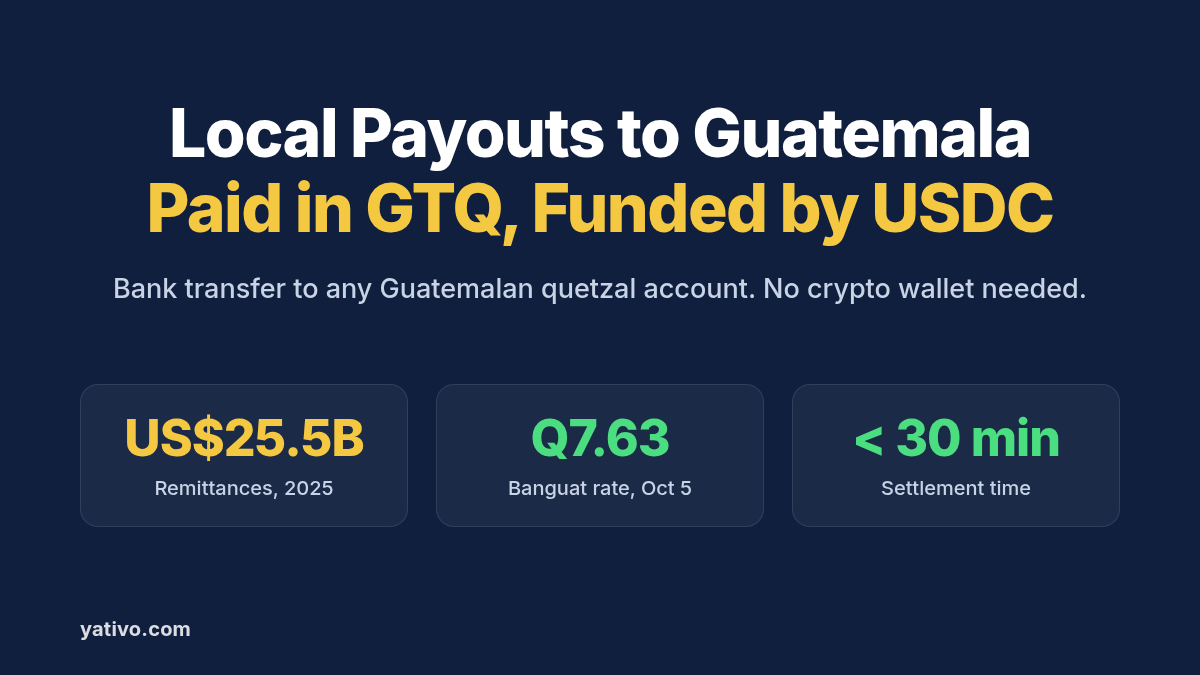
Money already flows into Guatemala at record scale. The country received US$25.53 billion in family remittances in 2025, according to the Banco de Guatemala, up 18.7% on 2024. Exports reached US$15.59 billion, led by apparel, coffee and bananas.
This guide covers why Guatemalan payouts break, how the stablecoin-funded flow works, and which recipient details you need. It then walks through your first GTQ payout by dashboard and by API.
Why Paying Out in Guatemala Is Harder Than It Should Be
Guatemala has a working interbank network and a large banking sector. The friction sits at the border, where your foreign payment meets currency conversion, cut-off times and bank fees.
The exchange rate is only the start. The Banco de Guatemala reference rate for October 5, 2026 was Q7.63456 per dollar. The rate your recipient’s bank applies to an inbound wire can sit well away from that reference.
Small cross-border transfers are expensive. Sending small amounts abroad costs an average of 6.36% of the amount sent, according to the World Bank. On a US$25,000 monthly payroll, that average would cost you US$1,590 every month. We break down more of these costs in the hidden costs of international payments.
Domestic transfers have limits and schedules. Immediate GuateACH transfers at Banrural are capped at Q20,000 and run from 7:00 a.m. to 9:00 p.m. Larger transfers move on weekdays only, in fixed credit windows.
The details have to be exact. A wrong account number, account type or ID number is the fastest route to a rejected payout and a week of emails.
Local Bank Transfer Payouts to Guatemala with a Stablecoin Layer: How It Works
Yativo is payment infrastructure, not a bank. We use stablecoins as the settlement layer between your balance and Guatemala. A licensed local payout partner then delivers the quetzales on the ground.
- You fund your Yativo float balance with a fiat or stablecoin deposit, such as USDC.
- Yativo converts the payout value to USDC and settles it on-chain.
- A licensed local payout partner in Guatemala receives the stablecoin settlement.
- The partner converts USDC to GTQ and sends a domestic bank transfer to the recipient’s account.
- Your recipient receives quetzales in their normal bank account.
Your recipient does not need a crypto wallet. They never see or touch stablecoins. On their side, the payment looks like any domestic transfer from a local sender.
Trade with the US makes this corridor matter. Guatemala bought US$10.89 billion of goods from the United States in 2025 and sold it US$4.75 billion. For more on the settlement layer, read how to receive international payments in stablecoins.
Supported Payout Rails for Guatemala
Yativo has two active local payout methods for Guatemala. Bank Transfer (GTQ) pays quetzales, and Bank Transfer (USD) pays dollars into a dollar account. Our Guatemala list also includes SWIFT for dollars.
Bank Transfer (GTQ)
Interbank transfers in Guatemala move over GuateACH. Banks such as BAM offer it in both quetzales and dollars, to monetary and savings accounts. Banrural credits immediate GuateACH transfers within 5 to 10 minutes.
Required details: the fields returned by the Guatemala payout form, gateway ID 763. Expect the holder’s name and ID, the bank, the account type and the account number.
Settlement time: payouts via Bank Transfer (GTQ) settle in under 30 minutes.
Best for: suppliers, contractors, call center teams and payroll recipients with a quetzal account.
USD alternatives
Bank Transfer (GTQ) delivers quetzales only. If your recipient holds a dollar account, use Bank Transfer (USD), gateway ID 764, which also settles in under 30 minutes. Our guide to local payouts to Guatemala in USD covers that rail step by step.
SWIFT, gateway ID 606, also pays USD, but timing depends on correspondent banks. Availability depends on your account, so check the live list before you build.
Recipient Details to Collect Before Your First GTQ Payout
The Guatemala payout form in your dashboard, or the authenticated GET /beneficiary/form/show/763 call, is the authoritative field list. Our public documentation does not publish this form yet. Collect the details below during onboarding so you can fill it without a round of emails.
- Holder type: individual or company.
- Legal name: full name as it appears on the DPI, or the registered company name.
- ID number: the DPI (personal identification document) for individuals, or the NIT (tax identification number) for companies.
- Bank: the recipient’s bank, for example Banco Industrial, Banrural or BAM.
- Account type: monetary (checking) or savings.
- Account number: the full number, copied from a statement or the bank’s app.
- Account currency: confirm the account holds quetzales, not dollars.
Ask for a screenshot of the account details from the bank’s app during onboarding. It removes most typing errors before the first payout.
How to Send a GTQ Payout via Yativo
Option 1: Dashboard (for manual payouts)
- Fund your Yativo float balance with either a fiat or a stablecoin deposit.
- Go to Transfer in your Yativo dashboard.
- Select the float wallet you are paying with, for example USD, EUR, MXN or whichever balance you funded.
- Choose the customer you are paying on behalf of. This step is necessary for fintechs that run payouts on behalf of their customers.
- Choose Guatemala as the destination country and the Bank Transfer (GTQ) payout method.
- Enter the recipient details the payout form asks for, such as the holder’s name, DPI or NIT, bank, account type and account number.
- Enter the amount in USD or GTQ.
- Review the quote: exchange rate, fees, delivery time and the exact GTQ amount your recipient receives.
- Confirm with your PIN and 2FA.
- Track the payout in real time and download the receipt for your records.
Option 2: API (for automated and bulk payouts)
Every endpoint below is in the Yativo API documentation. Production calls go to https://api.yativo.com/api/v1, and the sandbox runs at https://smtp.yativo.com/api/v1.
Authenticate every request with the X-Api-Key and X-Api-Secret headers. Each key only works from the server IPs listed on it. These API keys replaced bearer tokens, and login tokens stop working from servers on October 15, 2026, as covered in our October update. Every POST request also needs a unique Idempotency-Key header.
Step 1. Generate a USDC funding address on Solana to top up your USD balance:
POST https://api.yativo.com/api/v1/crypto/create-wallet
X-Api-Key: $YATIVO_API_KEY
X-Api-Secret: $YATIVO_API_SECRET
Idempotency-Key: 6c7d8e9f-0a1b-4c2d-9e3f-4a5b6c7d8e9f
Content-Type: application/json

{
  "currency": "USDC_SOL"
}
Step 2. List the payout methods available for Guatemala:
curl "https://api.yativo.com/api/v1/payment-methods/payout?country=GTM" \
  -H "X-Api-Key: $YATIVO_API_KEY" \
  -H "X-Api-Secret: $YATIVO_API_SECRET" \
  -H "Accept: application/json"
Bank Transfer (GTQ) is active and carries gateway ID 763. Always read the ID from the live response instead of hardcoding it.
Step 3. Fetch the required fields for that gateway:
GET https://api.yativo.com/api/v1/beneficiary/form/show/763
X-Api-Key: $YATIVO_API_KEY
X-Api-Secret: $YATIVO_API_SECRET
The response lists every required field and the accepted values for each one. Build your payment_data object from it. For field details, see API documentation.
Step 4. Create the beneficiary. Replace the placeholder with the fields the form returned:
POST https://api.yativo.com/api/v1/beneficiaries/payment-methods/
X-Api-Key: $YATIVO_API_KEY
X-Api-Secret: $YATIVO_API_SECRET
Idempotency-Key: 3b4c5d6e-7f8a-4b9c-8d0e-1f2a3b4c5d6e
Content-Type: application/json

{
  "gateway_id": 763,
  "nickname": "Textiles del Altiplano S.A.",
  "currency": "GTQ",
  "customer_id": "e8caa491-57b6-4c39-9e3a-d2c97e47fbf0",
  "payment_data": {
    "{field_from_form}": "{value}"
  }
}
Step 5. Optionally, lock your rate. Quotes hold for 5 minutes:
POST https://api.yativo.com/api/v1/exchange-rate
X-Api-Key: $YATIVO_API_KEY
X-Api-Secret: $YATIVO_API_SECRET
Idempotency-Key: 0e1f2a3b-4c5d-4e6f-9a7b-8c9d0e1f2a3b
Content-Type: application/json

{
  "from_currency": "USD",
  "to_currency": "GTQ",
  "method_id": 763,
  "method_type": "payout",
  "amount": 3000
}
Step 6. Initiate the payout from your USD balance:
POST https://api.yativo.com/api/v1/wallet/payout
X-Api-Key: $YATIVO_API_KEY
X-Api-Secret: $YATIVO_API_SECRET
Idempotency-Key: 5f6a7b8c-9d0e-4f1a-8b2c-3d4e5f6a7b8c
Content-Type: application/json

{
  "debit_wallet": "USD",
  "amount": 3000,
  "payment_method_id": 5308,
  "customer_id": "e8caa491-57b6-4c39-9e3a-d2c97e47fbf0",
  "quote_id": "4a72ecf8-6c8a-4e38-9971-8aabe9f785ed"
}
Use the id from the beneficiary response as payment_method_id. Leave out quote_id if you did not lock a rate. For bulk runs, repeat the call per beneficiary, as described on our payouts page.
Which Guatemala Payout Option Should You Use?
| Bank transfer (GTQ) | Bank transfer (USD) | SWIFT (USD) | |
| Settlement speed | Under 30 minutes | Under 30 minutes | Depends on correspondent banks |
| Required details | Name, ID, bank, account (see API documentation) | Name, ID, bank, dollar account (see API documentation) | See API documentation |
| Best for | Suppliers, contractors, payroll | Exporters and USD invoices | Banks that expect a wire |
| Availability | Active | Active | Active |
| Currency received | GTQ | USD | USD |
Best Practices for Guatemala Payouts
Match the ID to the account holder. Make sure the DPI or NIT belongs to the person or company that owns the account. Mismatches are a common reason for returns.
Agree on the invoice currency. Guatemalan law allows accounts in foreign currency, so many businesses hold both. Decide up front whether you pay quetzales or dollars, and collect the matching account.
Lock the rate on large payouts. Exchange-rate quotes hold for 5 minutes, so lock one for payroll runs and large invoices. You then know the exact quetzal amount before you confirm.
Stop hardcoding retired gateway IDs. The earlier ACH method for Guatemala, gateway 1358, was sunset on September 2, 2026. Read gateway IDs from the payout methods endpoint at runtime instead.
Run one playbook across Central America. The same flow works in nearby markets. See our guide to local payouts to Costa Rica and our breakdown of LATAM payout rails.
Frequently Asked Questions
Does my recipient in Guatemala need a crypto wallet?
No. Your recipient gets quetzales in their normal bank account. They never interact with stablecoins, and the payment arrives as a domestic transfer.
Is it legal and compliant to pay Guatemalan recipients this way?
Yes, when the payout runs through regulated infrastructure. Yativo is registered with FinCEN as a Money Services Business, registration number 31000270723339. A licensed local payout partner makes the domestic transfer, so your recipient sees a normal local payment. Your own tax and reporting duties still apply, so confirm them with your compliance advisor.
How long does a GTQ payout take?
Payouts via Yativo settle in under 30 minutes. Your quote also shows the delivery time before you confirm. For comparison, a large GuateACH transfer you send yourself is credited at fixed times, and after 3:45 p.m. it waits for the next business day.
What exchange rate will my recipient get?
Your quote shows the exact rate and the GTQ amount before you confirm. For context, the Banco de Guatemala reference rate for October 5, 2026 was Q7.63456 per dollar. Lock the quote for 5 minutes if you want certainty on a large payout.
Can I pay a Guatemalan company, not just a person?
Yes. Bank Transfer pays into monetary (checking) or savings accounts held by individuals or companies. For a company, collect its registered legal name and NIT along with the account details.
Can my recipient receive US dollars instead of quetzales?
Yes. Guatemala also has an active Bank Transfer (USD) method that pays into dollar accounts, and SWIFT pays USD as well. Check GET /payment-methods/payout?country=GTM for the methods enabled on your account.
Start Paying Out in Guatemala in Quetzales
Guatemala received US$25.53 billion in remittances in 2025, a sign of how much of its economy runs on money from abroad. Yativo lets you fund in USDC or USD and deliver GTQ to Guatemalan bank accounts through a licensed local payout partner. Your recipients get a domestic transfer in under 30 minutes, and you get one API for every payout. Book a demo to set up your first Guatemala payout.
Sources
- Banco de Guatemala: Ingreso de divisas por remesas familiares, 2002 a 2025
- Prensa Libre: Guatemala rompe récord histórico de remesas: US$25 mil 530 millones en 2025
- Banco de Guatemala: Tipo de cambio de referencia
- Diario de Centro América: Exportaciones crecieron 7.1 % durante el 2025
- Banrural: Transferencias ACH a otros bancos para empresas
- BAM: GuateACH Masivos
- Banco de Guatemala: Ley de Libre Negociación de Divisas, Decreto 94-2000
- World Bank: Remittance Prices Worldwide
- Yativo: Yativo API Documentation
- Yativo: Safer API access, three new virtual accounts and new payment links
- Yativo: Important Update: Streamlining Our Rail Network Effective September 2, 2026