
Your freelance designer in Quezon City asks to be paid on GCash, not by bank wire. A dollar remittance would cost them fees and a trip to cash out. They just want pesos in the app they already use every day.
GCash payouts to the Philippines with stablecoin settlement solve that. You fund in USDC or USD, lock a quote, and your recipient gets Philippine pesos (PHP) credited to their GCash wallet.
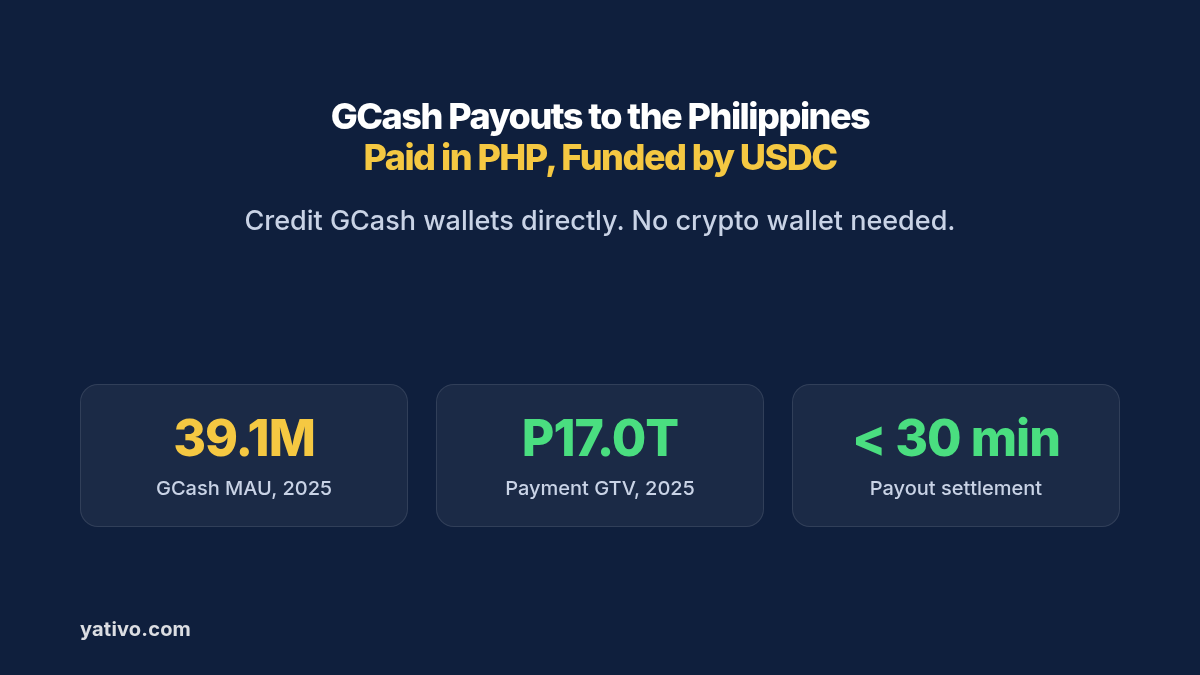
GCash is the dominant Philippine e-wallet. Parent company Mynt reported 39.1 million monthly active users and ₱17.0 trillion in payment-solutions gross transaction value in 2025, with about 90 million registered users. Overseas Filipino cash remittances reached about US$35.63 billion the same year.
This guide covers why GCash payouts matter, how the stablecoin-funded flow works, and which recipient details you need. It then walks through your first GCash payout by dashboard and by API.
Why Paying Out to GCash Is Harder Than It Should Be
Filipino recipients increasingly prefer e-wallets over bank branches. The friction for a foreign payer is still the border: FX conversion, remittance fees and the wrong delivery channel.
Small cross-border transfers are expensive. Sending small amounts abroad costs an average of 6.36% of the amount sent, according to the World Bank. On a US$5,000 monthly freelancer budget, that average would cost about US$318 every month. We break down more of these costs in the hidden costs of international payments.
Bank wires miss wallet-first recipients. Many contractors outside Metro Manila live on GCash more than on a traditional payroll account. Forcing a bank transfer adds onboarding friction.
Cash-out and remittance agents add delay. A classic remittance can still leave the recipient waiting in line. A wallet credit lands where they already spend.
The mobile number has to be exact. A wrong GCash number or a name mismatch is the fastest route to a rejected payout and a week of emails.
GCash Payouts to the Philippines with a Stablecoin Layer: How It Works
Yativo is payment infrastructure, not a bank. We use stablecoins as the settlement layer between your balance and the Philippines. A licensed local payout partner then credits the GCash wallet on the ground.
- You fund your Yativo float balance with a fiat or stablecoin deposit, such as USDC.
- Yativo converts the payout value to USDC and settles it on-chain.
- A licensed local payout partner in the Philippines receives the stablecoin settlement.
- The partner converts USDC to PHP and credits the recipient’s GCash wallet.
- Your recipient sees pesos in GCash, with no crypto steps on their side.
Your recipient does not need a crypto wallet. They never see or touch stablecoins. On their side, the payment looks like any domestic GCash credit.
Domestic instant rails backstop this corridor. InstaPay processed 4.656 billion transactions worth ₱11.554 trillion in 2025. For more on the settlement layer, read how to receive international payments in stablecoins.
Supported Payout Rails for Philippine Wallets and Banks
Yativo’s featured method for this guide is PHP Local Wallet with payment_method gcash. The same gateway also covers GrabPay, Maya and ShopeePay. Our Philippines list further includes PHP Bank Transfer, POBO local and SWIFT.
PHP Local Wallet: GCash (featured)
PHP Local Wallet, gateway ID 1368, is the single wallet gateway. Select payment_method gcash for GCash. Do not invent a separate gateway ID for GCash.
Required details: the fields returned by GET /beneficiary/form/show/1368, including payment_method set to gcash. Expect the holder’s name and the mobile number linked to GCash. For exact field names, see API documentation.
Settlement time: GCash payouts settle in under 30 minutes.
Best for: freelancers, marketplace sellers, field agents and payroll recipients who live on GCash.
Sibling wallets and bank transfer
Under the same gateway 1368, payment_method ph_grabpay, ph_paymaya and ph_shopee cover GrabPay, Maya and ShopeePay. See GrabPay payouts guide, Maya payouts guide and ShopeePay payouts guide. For bank accounts, use Philippines bank transfer guide with gateway ID 1364.
POBO and USD alternatives
POBO (Local), gateway ID 1063, pays PHP next business day (T+1). SWIFT, gateway ID 689, pays USD next business day (T+1). Availability depends on your account.
Recipient Details to Collect Before Your First GCash Payout
The PHP Local Wallet form in your dashboard, or GET /beneficiary/form/show/1368, is the authoritative field list. Our public documentation does not publish this form yet. Collect the details below during onboarding.
- Holder type: individual (most GCash payouts) or company if the form allows.
- Legal name: full name as registered on the GCash account.
- GCash mobile number: the PH mobile number linked to the wallet.
- payment_method: set to gcash under gateway ID 1368.
- ID details: any KYC fields the form returns.
Ask for a GCash profile screenshot during onboarding. It removes most number and name mismatches before the first payout.
How to Send a GCash Payout via Yativo
Option 1: Dashboard (for manual payouts)
- Fund your Yativo float balance with either a fiat or a stablecoin deposit.
- Go to Transfer in your Yativo dashboard.
- Select the float wallet you are paying with, for example USD, EUR, MXN or whichever balance you funded.
- Choose the customer you are paying on behalf of. This step is necessary for fintechs that run payouts on behalf of their customers.
- Choose the Philippines as the destination country and the PHP Local Wallet method, then select GCash.
- Enter the recipient details the payout form asks for, such as the holder’s name and GCash mobile number.
- Enter the amount in USD or PHP.
- Review the quote: exchange rate, fees, delivery time and the exact PHP amount your recipient receives.
- Confirm with your PIN and 2FA.
- Track the payout in real time and download the receipt for your records.
Option 2: API (for automated and bulk payouts)
Every endpoint below is in the Yativo API documentation. Production calls go to https://api.yativo.com/api/v1, and the sandbox runs at https://smtp.yativo.com/api/v1.
Authenticate every request with the X-Api-Key and X-Api-Secret headers. Each key only works from the server IPs listed on it. These API keys replaced bearer tokens, and login tokens stop working from servers on October 15, 2026, as covered in our October update. Every POST request also needs a unique Idempotency-Key header.
Step 1. Generate a USDC funding address on Solana to top up your USD balance:
POST https://api.yativo.com/api/v1/crypto/create-wallet
X-Api-Key: $YATIVO_API_KEY
X-Api-Secret: $YATIVO_API_SECRET
Idempotency-Key: a55e1368-g001-4a7b-9c0d-1e2f3a4b5c01
Content-Type: application/json

{
  "currency": "USDC_SOL"
}
Step 2. List the payout methods available for the Philippines:
curl "https://api.yativo.com/api/v1/payment-methods/payout?country=PHL" \
  -H "X-Api-Key: $YATIVO_API_KEY" \
  -H "X-Api-Secret: $YATIVO_API_SECRET" \
  -H "Accept: application/json"
PHP Local Wallet is active and carries gateway ID 1368. GCash is selected with payment_method gcash inside payment_data, not as a separate gateway.
Step 3. Fetch the required fields for that gateway:
GET https://api.yativo.com/api/v1/beneficiary/form/show/1368
X-Api-Key: $YATIVO_API_KEY
X-Api-Secret: $YATIVO_API_SECRET
The response lists every required field and accepted values, including wallet payment_method options. Build your payment_data object from it and set payment_method to gcash. For field details, see API documentation.
Step 4. Create the beneficiary. Replace the placeholder with the fields the form returned:
POST https://api.yativo.com/api/v1/beneficiaries/payment-methods/
X-Api-Key: $YATIVO_API_KEY
X-Api-Secret: $YATIVO_API_SECRET
Idempotency-Key: a55e1368-g002-4b8c-0d1e-2f3a4b5c6d02
Content-Type: application/json

{
  "gateway_id": 1368,
  "nickname": "GCash - Ana Reyes",
  "currency": "PHP",
  "customer_id": "e8caa491-57b6-4c39-9e3a-d2c97e47fbf0",
  "payment_data": {
    "{field_from_form}": "{value}"
  }
}
Step 5. Optionally, lock your rate. Quotes hold for 5 minutes:
POST https://api.yativo.com/api/v1/exchange-rate
X-Api-Key: $YATIVO_API_KEY
X-Api-Secret: $YATIVO_API_SECRET
Idempotency-Key: a55e1368-g003-4c9d-0e1f-2a3b4c5d6e03
Content-Type: application/json

{
  "from_currency": "USD",
  "to_currency": "PHP",
  "method_id": 1368,
  "method_type": "payout",
  "amount": 500
}
Step 6. Initiate the payout from your USD balance:
POST https://api.yativo.com/api/v1/wallet/payout
X-Api-Key: $YATIVO_API_KEY
X-Api-Secret: $YATIVO_API_SECRET
Idempotency-Key: a55e1368-g004-4d0e-1f2a-3b4c5d6e7f04
Content-Type: application/json

{
  "debit_wallet": "USD",
  "amount": 500,
  "payment_method_id": 8301,
  "customer_id": "e8caa491-57b6-4c39-9e3a-d2c97e47fbf0",
  "quote_id": "4a72ecf8-6c8a-4e38-9971-8aabe9f785ed"
}
Use the id from the beneficiary response as payment_method_id. For bulk runs, repeat the call per beneficiary, as described on our payouts page.
Which Philippines Payout Option Should You Use?
| GCash (1368) | Other wallets (1368) | PHP Bank Transfer | SWIFT (USD) | |
| Settlement speed | Under 30 minutes | Under 30 minutes | Under 30 minutes | Next business day (T+1) |
| Required details | Name, GCash number, payment_method gcash | Name, wallet ID, payment_method (see API documentation) | Name, bank, account (see API documentation) | See API documentation |
| Best for | GCash-first freelancers and sellers | GrabPay, Maya, ShopeePay recipients | Banked suppliers and payroll | Recipients who want USD |
| Availability | Active | Active | Active | Active |
| Currency received | PHP | PHP | PHP | USD |
Best Practices for GCash Payouts
Confirm GCash versus bank up front. Some recipients want a bank credit for larger invoices. Offer Philippines bank transfer guide when amounts grow.
Match the name to the GCash profile. Name mismatches are a common reject reason. Capture the name exactly as the app shows it.
Store payment_method as gcash, not a fake gateway ID. All four Philippine wallets share gateway 1368. Hardcoding a invented GCash ID will break your integration.
Lock the rate on larger batches. Exchange-rate quotes hold for 5 minutes, so lock one for payroll-style wallet runs.
Reuse one Philippines wallet playbook. The same form powers GrabPay payouts guide, Maya payouts guide and ShopeePay payouts guide. Keep onboarding fields consistent.
Frequently Asked Questions
Does my GCash recipient need a crypto wallet?
No. Your recipient gets Philippine pesos in their GCash wallet. They never interact with stablecoins, and the payment arrives as a normal e-wallet credit.
Is it legal and compliant to pay GCash wallets this way?
Yes, when the payout runs through regulated infrastructure. Yativo is registered with FinCEN as a Money Services Business, registration number 31000270723339. A licensed local payout partner makes the domestic delivery. Your own tax and reporting duties still apply, so confirm them with your compliance advisor.
How long does a GCash payout take?
GCash payouts via PHP Local Wallet, gateway ID 1368 with payment_method gcash, settle in under 30 minutes. POBO (Local) 1063 and SWIFT 689 settle next business day (T+1). Your quote shows the delivery time before you confirm.
Is GCash a separate gateway ID?
No. Do not invent a separate gateway for GCash. It is a payment_method value (gcash) under PHP Local Wallet, gateway ID 1368, alongside GrabPay, Maya and ShopeePay.
What details do I need for a GCash payout?
Collect the legal name that matches the GCash account and the mobile number linked to the wallet. The dashboard form or GET /beneficiary/form/show/1368 lists every required field. Set payment_method to gcash. For payment_data field names, see API documentation.
Can I pay a bank account instead of GCash?
Yes. Use PHP Bank Transfer, gateway ID 1364, covered in our Philippines bank transfer guide. For other wallets on gateway 1368, see GrabPay payouts guide.
Start Paying Out to GCash in Pesos
GCash served 39.1 million monthly active users and ₱17.0 trillion in payment GTV in 2025, while the Philippines took in about US$35.63 billion in overseas remittances. Yativo lets you fund in USDC or USD and deliver PHP to GCash through a licensed local payout partner. Your recipients get a wallet credit in under 30 minutes, and you get one API under gateway 1368. Book a demo to set up your first GCash payout, or contact sales if you already know your corridor volume.
Sources
- Mynt: GCash parent Mynt submits SEC registration statement for proposed IPO
- Bangko Sentral ng Pilipinas: Overseas Filipino Cash Remittances
- BusinessWorld: InstaPay, PESONet transfers reach P24.7 trillion in 2025
- World Bank: Remittance Prices Worldwide
- Yativo: Yativo API Documentation
- Yativo: Safer API access, three new virtual accounts and new payment links