
Your US gig worker finished the shift and wants the payout on the Visa debit card already in their wallet. Waiting for a bank ACH credit until Monday is not an option.
Visa Push-to-Card payouts to the United States with stablecoin settlement solve that. You fund in USDC or USD, confirm a quote, and a licensed local payout partner pushes dollars to the recipient’s Visa debit card.
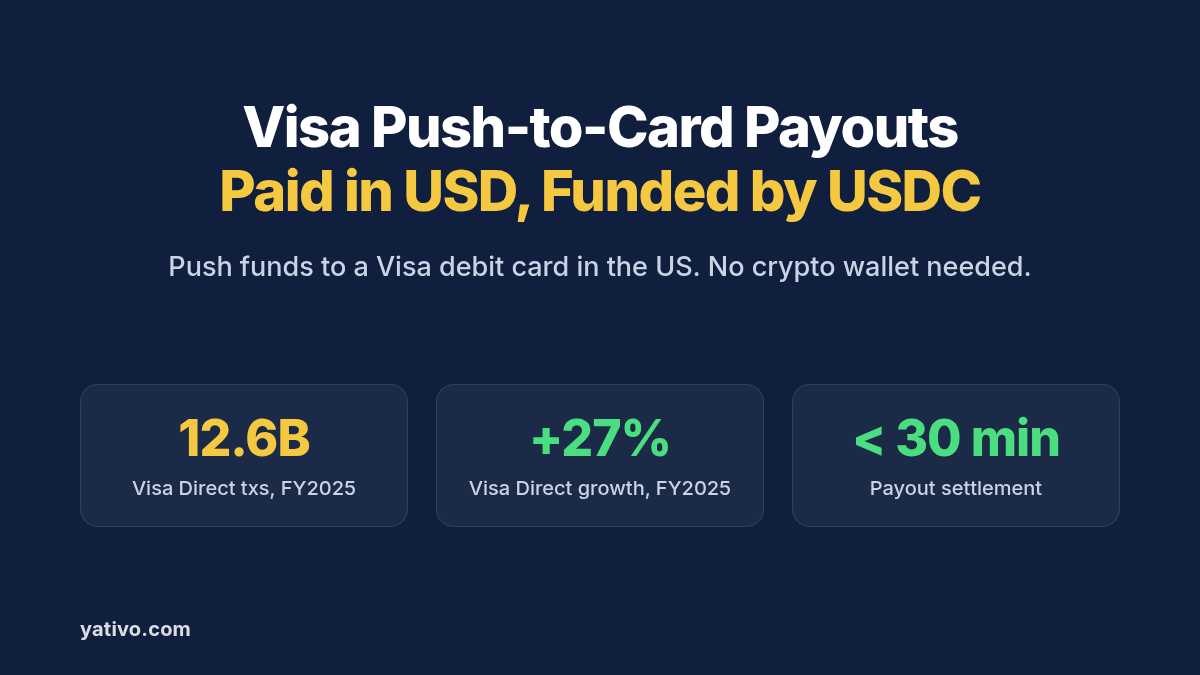
Push-to-card rails ride on Visa Direct, which processed 12.6 billion transactions in fiscal 2025, up 27% year over year, according to Visa. That scale is why platforms treat card disbursements as a first-class payout option next to ACH and wires.
This guide covers why card payouts beat slow wires for many US recipients, how the stablecoin-funded flow works, and which card details you need. It then walks through your first payout by dashboard and by API.
Why Visa Push-to-Card Payouts to the United States Are Harder Than They Should Be
Most US adults already carry a debit card. The friction is connecting your overseas float to a domestic card push without building a full card-issuing stack.
Bank wires are the wrong tool for a US$40 gig payout. Correspondent fees and multi-day settlement destroy small disbursements. The World Bank still cites an average cost of 6.36% for small amounts sent abroad.
ACH is great until the recipient has no bank login handy. Some workers spend from a debit card long before they check a banking app. Card push meets them where the money is used.
Card data must be exact. A wrong PAN, expiry or name match fails the push. Collect details through a secure form, not a shared spreadsheet.
Issuing a new card is a different product. If you need to create prepaid cards instead of pushing to existing Visa debit cards, see Yativo Paycards. This guide focuses on push-to-card credits.
Visa Push-to-Card Payouts to the United States with a Stablecoin Layer: How It Works
Yativo is payment infrastructure, not a bank. We use stablecoins as the settlement layer between your balance and the United States. A licensed local payout partner then pushes the Visa debit credit on the ground.
- You fund your Yativo float balance with a fiat or stablecoin deposit, such as USDC.
- Yativo converts the payout value to USDC and settles it on-chain.
- A licensed local payout partner in the United States receives the stablecoin settlement.
- The partner converts USDC to US dollars and pushes the funds to the recipient’s Visa debit card.
- Your recipient sees the dollars on their debit card and can spend or withdraw per their bank’s rules.
Your recipient does not need a crypto wallet. They never see or touch stablecoins. On their side, the payment looks like a card credit.
Visa’s own reporting puts Visa Direct among its fastest-growing money-movement products, with more than 12.5 billion transactions in 2025 cited in the annual CEO message. For more on the settlement layer, read how to receive international payments in stablecoins.
Supported Payout Rails for the United States via Visa Push-to-Card
Yativo’s featured method for this guide is PayCard (Visa), gateway ID 892. Your account may also show Pay2Card, gateway ID 891, as a sibling card rail. Always read the live ID from the payout methods endpoint.
PayCard / Visa Push-to-Card (USD)
This rail pushes USD to an eligible Visa debit card in the United States. It is built for instant-style disbursements where the recipient already holds a Visa debit product.
Required details: the fields returned by the United States payout form for gateway ID 892. Expect cardholder name and the Visa debit card fields the form lists. For field details, see API documentation.
Settlement time: featured Visa Push-to-Card payouts settle in under 30 minutes.
Best for: gig platforms, refunds, earned-wage access style disbursements and marketplace seller payouts to cards.
Other United States options
When the recipient prefers a bank account, use ACH payouts to the United States, Fedwire payouts to the United States or local bank transfer payouts to the United States. SWIFT (gateway ID 745) remains available for slower international wires.
Recipient Details to Collect Before Your First Visa Push-to-Card Payout
The payout form for gateway 892 is the authoritative field list. Our public API documentation does not publish that form yet, so read it from your dashboard or from the form endpoint shown below.
- Cardholder name: as embossed or printed on the Visa debit card.
- Card details: the Visa debit fields the form returns (for example card number and expiry). Never store full PANs in chat logs.
- Billing or contact details: if the form asks for address, email or phone.
- Holder type: individual or company, when required.
Collect card details through your secure onboarding flow or the Yativo dashboard form. Do not ask recipients to paste full card numbers into email.
How to Send a Visa Push-to-Card Payout to the United States via Yativo
Option 1: Dashboard (for manual payouts)
- Fund your Yativo float balance with either a fiat or a stablecoin deposit.
- Go to Transfer in your Yativo dashboard.
- Select the float wallet you are paying with, for example USD, EUR, MXN or whichever balance you funded.
- Choose the customer you are paying on behalf of. This step is necessary for fintechs that run payouts on behalf of their customers.
- Choose the United States as the destination country and the Visa Push-to-Card (PayCard) payout method.
- Enter the recipient details the payout form asks for, such as the cardholder name and Visa debit card details the form lists.
- Enter the amount in USD.
- Review the quote: fees, delivery time and the exact USD amount your recipient receives.
- Confirm with your PIN and 2FA.
- Track the payout in real time and download the receipt for your records.
Option 2: API (for automated and bulk payouts)
Every endpoint below is in the Yativo API documentation. Production calls go to https://api.yativo.com/api/v1, and the sandbox runs at https://smtp.yativo.com/api/v1.
Authenticate every request with the X-Api-Key and X-Api-Secret headers. Each key only works from the server IPs listed on it. These API keys replaced bearer tokens, and login tokens stop working from servers on October 15, 2026, as covered in our October update. Every POST request also needs a unique Idempotency-Key header.
Step 1. Generate a USDC funding address on Solana to top up your USD balance:
POST https://api.yativo.com/api/v1/crypto/create-wallet
X-Api-Key: $YATIVO_API_KEY
X-Api-Secret: $YATIVO_API_SECRET
Idempotency-Key: c9d0e1f2-a3b4-4567-c890-def123456701
Content-Type: application/json

{
  "currency": "USDC_SOL"
}
Step 2. List the payout methods available for the United States:
curl "https://api.yativo.com/api/v1/payment-methods/payout?country=USA" \
  -H "X-Api-Key: $YATIVO_API_KEY" \
  -H "X-Api-Secret: $YATIVO_API_SECRET" \
  -H "Accept: application/json"
PayCard (Visa) is active and carries gateway ID 892. Pay2Card 891 may also appear. Always read the ID from the live response instead of hardcoding it.
Step 3. Fetch the required fields for that gateway:
GET https://api.yativo.com/api/v1/beneficiary/form/show/892
X-Api-Key: $YATIVO_API_KEY
X-Api-Secret: $YATIVO_API_SECRET
The response lists every required field and the accepted values for each one. Build your payment_data object from it. For field details, see API documentation.
Step 4. Create the beneficiary. Replace the placeholder with the fields the form returned:
POST https://api.yativo.com/api/v1/beneficiaries/payment-methods/
X-Api-Key: $YATIVO_API_KEY
X-Api-Secret: $YATIVO_API_SECRET
Idempotency-Key: d0e1f2a3-b4c5-4678-d901-ef1234567802
Content-Type: application/json

{
  "gateway_id": 892,
  "nickname": "Gig Driver Card Payout",
  "currency": "USD",
  "customer_id": "e8caa491-57b6-4c39-9e3a-d2c97e47fbf0",
  "payment_data": {
    "{field_from_form}": "{value}"
  }
}
Step 5. Initiate the payout from your USD balance:
POST https://api.yativo.com/api/v1/wallet/payout
X-Api-Key: $YATIVO_API_KEY
X-Api-Secret: $YATIVO_API_SECRET
Idempotency-Key: f2a3b4c5-d6e7-4890-f123-123456789a04
Content-Type: application/json

{
  "debit_wallet": "USD",
  "amount": 350,
  "payment_method_id": 7303,
  "customer_id": "e8caa491-57b6-4c39-9e3a-d2c97e47fbf0"
}
Use the id from the beneficiary response as payment_method_id. Your dashboard quote shows fees and the exact dollar amount before you confirm. For bulk runs, repeat the call per beneficiary, as described on our payouts page.
Which United States Payout Option Should You Use?
| Visa Push-to-Card | ACH | Fedwire | Local bank transfer | USD via SWIFT | |
| Settlement speed | Under 30 minutes | Under 30 minutes | Under 30 minutes | Under 30 minutes | Depends on correspondent banks |
| Required details | Visa debit card fields (see API documentation) | Name, ABA, account (see API documentation) | Name, ABA, account (see API documentation) | Bank account details (see API documentation) | See API documentation |
| Best for | Instant card disbursements | Payroll and recurring credits | High-value same-day bank credits | General US bank payouts | Classic international wires |
| Availability | Active | Active | Active | Active | Active |
| Currency received | USD | USD | USD | USD | USD |
Best Practices for Visa Push-to-Card Payouts to the United States
Only push to debit cards the form accepts. Confirm Visa debit eligibility during onboarding. Do not assume every plastic card can receive a push.
Protect card data like PCI material. Use the dashboard or a vaulted form. Never keep full PANs in tickets or Slack.
Offer a bank fallback. If a card push fails, route the same recipient to ACH payouts to the United States or local bank transfer payouts to the United States with stored bank details.
Keep USDBASE straight on the collection side. United States virtual account deposits use currency code USDBASE, separate from the USD float you debit for card payouts.
Match the product to the use case. Push-to-card credits an existing Visa debit card. Issuing new prepaid cards is covered in our Paycards post.
Quote before every push. Show the recipient the exact USD amount and delivery time before you confirm with PIN and 2FA.
Frequently Asked Questions
Does my recipient in the United States need a crypto wallet?
No. Your recipient gets US dollars pushed to their Visa debit card. They never interact with stablecoins, and they spend from the card like any other debit balance.
Is it legal and compliant to pay US cardholders this way?
Yes, when the payout runs through regulated infrastructure. Yativo is registered with FinCEN as a Money Services Business, registration number 31000270723339. A licensed local payout partner pushes the card credit. Your own tax and reporting duties still apply.
How long does a Visa Push-to-Card payout take?
Featured Visa Push-to-Card payouts settle in under 30 minutes.
What card types can receive the payout?
This rail is built for Visa debit push-to-card flows. Collect the exact card fields the payout form returns. For field details, see API documentation.
When should I use a card push instead of ACH or Fedwire?
Use Visa Push-to-Card when the recipient wants funds on a debit card they already carry, especially for gig, refund and instant disbursement use cases. Use ACH payouts to the United States or Fedwire payouts to the United States when they prefer a bank account credit.
Is this the same as Yativo Paycards?
Not exactly. Paycards are reloadable prepaid cards you can issue, as covered in our Paycards launch post. Visa Push-to-Card credits an existing Visa debit card the recipient already holds.
Start Sending Visa Push-to-Card Payouts to the United States Today
With 12.6 billion Visa Direct transactions in fiscal 2025, US recipients already know how to spend from a debit card. Yativo lets you fund in USDC or USD and push dollars to a Visa debit card through a licensed local payout partner. Your recipients get funds in under 30 minutes, with no crypto wallet on their side. Book a demo to set up your first Visa Push-to-Card payout.
Sources
- Visa: Tap, Send, Done: How Payments Became Real-Time (Visa Direct blog)
- Visa: Chairman and CEO Message (annual report)
- Visa: Fiscal Fourth Quarter and Full-Year 2025 Financial Results
- World Bank: Remittance Prices Worldwide
- Yativo: Yativo API Documentation
- Yativo: Safer API access, three new virtual accounts and new payment links
- Yativo: Introducing Reloadable Paycards
- Yativo: How to Receive International Payments in Stablecoins