
Your US vendor invoice is due, and finance just wants dollars in the supplier’s checking account. They do not care whether the clearing label says ACH, wire or bank transfer. They care that it lands today.
Local bank transfer payouts to the United States with stablecoin settlement cover that need. You fund in USDC or USD, confirm a quote, and a licensed local payout partner credits the recipient’s US bank account over a domestic rail.
US bank accounts already clear enormous domestic volume. The ACH Network alone processed 35.2 billion payments worth US$93 trillion in 2025, while Fedwire originated 217.3 million transfers. Local bank transfer payouts sit in that same domestic last mile.
This guide covers why paying a US bank account from abroad still feels heavy, how the stablecoin-funded flow works, and which details you need. It then walks through your first payout by dashboard and by API.
Why Local Bank Transfer Payouts to the United States Are Harder Than They Should Be
Paying a US IBAN equivalent should be simple. In practice, many cross-border stacks only offer SWIFT into the US, even when a domestic credit would be faster and cheaper.
International wires still tax small invoices. The World Bank puts the average cost of sending small amounts abroad at 6.36% of the amount sent. On US$50,000 a month in US vendor payments, that average would cost you US$3,180 every month.
Rail names confuse ops teams. ACH, Fedwire and “bank transfer” can all credit the same account. Your dashboard may show more than one United States method. Pick the gateway your account enables and stick to its form fields.
ABA mistakes still dominate returns. A transposed digit in the routing or account number is the fastest path to a failed payout and a support ticket.
Stablecoin settlement is invisible to the recipient. They should never need a wallet. If someone asks them for a seed phrase, that is not your payout flow. We explain the layer in how to receive international payments in stablecoins.
Local Bank Transfer Payouts to the United States with a Stablecoin Layer: How It Works
Yativo is payment infrastructure, not a bank. We use stablecoins as the settlement layer between your balance and the United States. A licensed local payout partner then delivers the dollars on the ground.
- You fund your Yativo float balance with a fiat or stablecoin deposit, such as USDC.
- Yativo converts the payout value to USDC and settles it on-chain.
- A licensed local payout partner in the United States receives the stablecoin settlement.
- The partner converts USDC to US dollars and sends a domestic bank transfer to the recipient’s account.
- Your recipient receives dollars in their normal US bank account.
Your recipient does not need a crypto wallet. They never see or touch stablecoins. On their side, the payment looks like any domestic bank credit.
USD Bank Transfer is a distinct active gateway from the dedicated ACH and Fedwire rows. Use those sibling guides when you need the named clearing networks specifically.
Supported Payout Rails for the United States via Local Bank Transfer
Yativo’s featured method for this guide is USD Bank Transfer, gateway ID 1362. Always read the live ID from the payout methods endpoint for your account.
USD Bank Transfer (local)
This method pays US dollars into a United States bank account identified by the details the payout form returns. Depending on the form, that can look like an ACH-style or wire-style domestic credit.
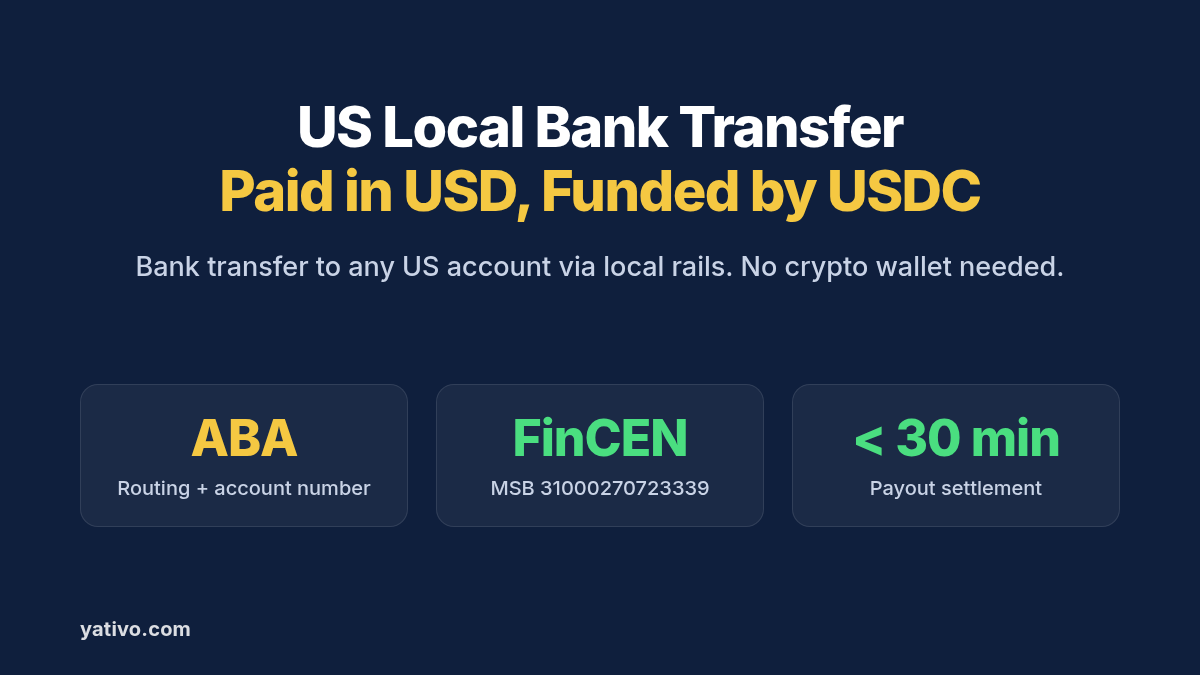
Required details: the fields returned by the United States payout form for gateway ID 1362. Expect the holder’s legal name, ABA routing number, account number and account type. For field details, see API documentation.
Settlement time: featured local bank transfer payouts settle in under 30 minutes.
Best for: supplier invoices, contractor payouts and marketplace settlements when you want a general US bank credit path.
Sibling rails and SWIFT
For named clearing networks, use ACH payouts to the United States or Fedwire payouts to the United States. For cardholders, use Visa Push-to-Card payouts to the United States. SWIFT (gateway ID 745) remains the slower international option.
Recipient Details to Collect Before Your First US Bank Transfer
The payout form for gateway 1362 is the authoritative field list. Our public API documentation does not publish that form yet, so read it from your dashboard or from the form endpoint shown below.
- Holder type: individual or company.
- Legal name: full name as it appears on the bank account.
- ABA routing number: the 9-digit US routing number.
- Account number: the full deposit account number.
- Account type: checking or savings.
- Optional bank metadata: bank name or address if the form asks for it.
- Contact details: email and phone for receipt confirmation.
Ask for a voided check or bank portal screenshot during onboarding. It confirms routing and account digits before the first payout.
How to Send a Local Bank Transfer Payout to the United States via Yativo
Option 1: Dashboard (for manual payouts)
- Fund your Yativo float balance with either a fiat or a stablecoin deposit.
- Go to Transfer in your Yativo dashboard.
- Select the float wallet you are paying with, for example USD, EUR, MXN or whichever balance you funded.
- Choose the customer you are paying on behalf of. This step is necessary for fintechs that run payouts on behalf of their customers.
- Choose the United States as the destination country and the Local Bank Transfer (USD Bank Transfer) payout method.
- Enter the recipient details the payout form asks for, such as the holder’s name, ABA routing number, account number and account type.
- Enter the amount in USD.
- Review the quote: fees, delivery time and the exact USD amount your recipient receives.
- Confirm with your PIN and 2FA.
- Track the payout in real time and download the receipt for your records.
Option 2: API (for automated and bulk payouts)
Every endpoint below is in the Yativo API documentation. Production calls go to https://api.yativo.com/api/v1, and the sandbox runs at https://smtp.yativo.com/api/v1.
Authenticate every request with the X-Api-Key and X-Api-Secret headers. Each key only works from the server IPs listed on it. These API keys replaced bearer tokens, and login tokens stop working from servers on October 15, 2026, as covered in our October update. Every POST request also needs a unique Idempotency-Key header.
Step 1. Generate a USDC funding address on Solana to top up your USD balance:
POST https://api.yativo.com/api/v1/crypto/create-wallet
X-Api-Key: $YATIVO_API_KEY
X-Api-Secret: $YATIVO_API_SECRET
Idempotency-Key: a3b4c5d6-e7f8-4901-a234-56789abcde01
Content-Type: application/json

{
  "currency": "USDC_SOL"
}
Step 2. List the payout methods available for the United States:
curl "https://api.yativo.com/api/v1/payment-methods/payout?country=USA" \
  -H "X-Api-Key: $YATIVO_API_KEY" \
  -H "X-Api-Secret: $YATIVO_API_SECRET" \
  -H "Accept: application/json"
USD Bank Transfer is active and carries gateway ID 1362. Always read the ID from the live response instead of hardcoding it.
Step 3. Fetch the required fields for that gateway:
GET https://api.yativo.com/api/v1/beneficiary/form/show/1362
X-Api-Key: $YATIVO_API_KEY
X-Api-Secret: $YATIVO_API_SECRET
The response lists every required field and the accepted values for each one. Build your payment_data object from it. For field details, see API documentation.
Step 4. Create the beneficiary. Replace the placeholder with the fields the form returned:
POST https://api.yativo.com/api/v1/beneficiaries/payment-methods/
X-Api-Key: $YATIVO_API_KEY
X-Api-Secret: $YATIVO_API_SECRET
Idempotency-Key: b4c5d6e7-f8a9-4012-b345-6789abcdef02
Content-Type: application/json

{
  "gateway_id": 1362,
  "nickname": "West Coast Supplies Inc",
  "currency": "USD",
  "customer_id": "e8caa491-57b6-4c39-9e3a-d2c97e47fbf0",
  "payment_data": {
    "{field_from_form}": "{value}"
  }
}
Step 5. Initiate the payout from your USD balance:
POST https://api.yativo.com/api/v1/wallet/payout
X-Api-Key: $YATIVO_API_KEY
X-Api-Secret: $YATIVO_API_SECRET
Idempotency-Key: d6e7f8a9-b0c1-4234-d567-89abcdef1204
Content-Type: application/json

{
  "debit_wallet": "USD",
  "amount": 8500,
  "payment_method_id": 7404,
  "customer_id": "e8caa491-57b6-4c39-9e3a-d2c97e47fbf0"
}
Use the id from the beneficiary response as payment_method_id. Your dashboard quote shows fees and the exact dollar amount before you confirm. For bulk runs, repeat the call per beneficiary, as described on our payouts page.
Which United States Payout Option Should You Use?
| Local bank transfer | ACH | Fedwire | Visa Push-to-Card | USD via SWIFT | |
| Settlement speed | Under 30 minutes | Under 30 minutes | Under 30 minutes | Under 30 minutes | Depends on correspondent banks |
| Required details | Name, ABA, account (see API documentation) | Name, ABA, account (see API documentation) | Name, ABA, account (see API documentation) | Visa debit card fields (see API documentation) | See API documentation |
| Best for | General US bank credits | Payroll and recurring credits | High-value same-day wires | Instant card disbursements | Classic international wires |
| Availability | Active (gateway 1362) | Active | Active | Active | Active |
| Currency received | USD | USD | USD | USD | USD |
Best Practices for Local Bank Transfer Payouts to the United States
Use the gateway your account returns. Do not hardcode 1362 if your live methods list shows a different enabled ID for the same corridor.
Keep ACH and Fedwire playbooks next to this one. Named rails help when a recipient or auditor asks which clearing network you used.
Verify ABA details once, then reuse the beneficiary. Typing routing numbers from memory is how returns start.
Remember USDBASE for virtual accounts. Collection into a United States virtual account uses currency code USDBASE.
Watch the cost of SWIFT-only habits. We unpack markups in the hidden costs of international payments.
Reuse the same ops discipline across corridors. The checklist you use for US bank credits also helps when you pay contractors in LATAM.
Frequently Asked Questions
Does my recipient in the United States need a crypto wallet?
No. Your recipient gets US dollars in their normal US bank account. They never interact with stablecoins, and the credit looks like a domestic bank transfer.
Is it legal and compliant to pay US recipients this way?
Yes, when the payout runs through regulated infrastructure. Yativo is registered with FinCEN as a Money Services Business, registration number 31000270723339. A licensed local payout partner makes the domestic transfer. Your own tax and reporting duties still apply.
How long does a local bank transfer payout take?
Featured local bank transfer payouts to the United States settle in under 30 minutes.
How is this different from ACH or Fedwire on Yativo?
USD Bank Transfer (gateway 1362) is a separate active method from the dedicated ACH and Fedwire gateway rows. Use the method your account enables, and read our ACH payouts to the United States and Fedwire payouts to the United States when you need those specific rails.
Can I pay a Visa debit card instead?
Yes. See our Visa Push-to-Card payouts to the United States when the recipient prefers a card credit.
Which currency code do US virtual accounts use?
United States virtual account deposits use currency code USDBASE, not the deprecated USD code. Keep that distinct from the USD float you debit for payouts.
Start Sending Local Bank Transfer Payouts to the United States
US recipients already clear money through domestic bank rails at massive scale, from ACH’s 35.2 billion payments to Fedwire’s 217 million transfers. Yativo lets you fund in USDC or USD and deliver dollars to US bank accounts through a licensed local payout partner. Your recipients get a domestic credit in under 30 minutes, with no crypto wallet on their side. Book a demo to set up your first local bank transfer payout to the United States.
Sources
- Nacha: Same Day ACH and Business-to-Business Payments Propel ACH Network Volume Growth in 2025
- Federal Reserve Financial Services: Fedwire Funds Service – Annual Statistics
- World Bank: Remittance Prices Worldwide
- Yativo: Yativo API Documentation
- Yativo: Safer API access, three new virtual accounts and new payment links
- Yativo: How to Receive International Payments in Stablecoins
- Yativo: Hidden Costs of International Payments