
Your supplier in São Paulo sent an invoice with a bank code, an agência, a conta and a CNPJ. There is no Pix key, and your international wire will take days to land.
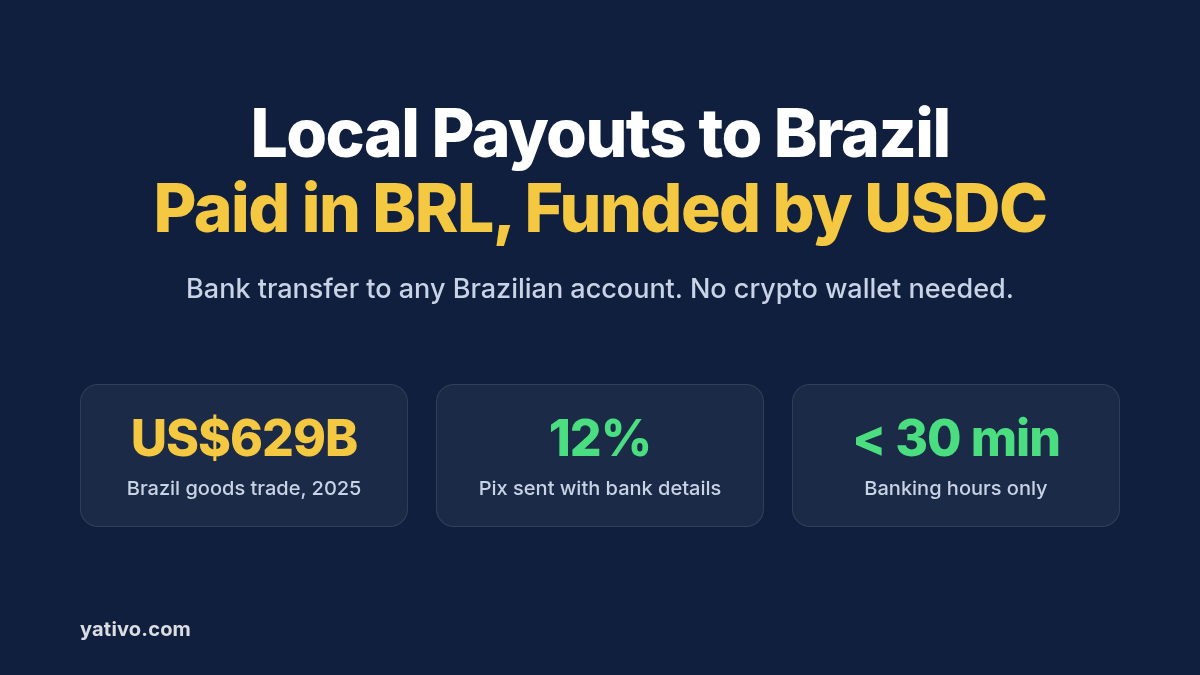
Local bank transfer payouts to Brazil with stablecoin settlement solve that. You fund in USDC or USD, lock a quote, and your recipient gets reais (BRL) in their own Brazilian bank account.
The volume behind these payments is large. Brazil exported US$348.7 billion and imported US$280.4 billion in goods in 2025, according to MDIC data reported by g1. Every one of those trade lanes has suppliers, agents and contractors waiting to be paid.
This guide covers why Brazil bank payouts break, how the stablecoin-funded flow works and which recipient details you need. It then walks through your first BRL payout by dashboard and by API.
Why Paying Brazilian Bank Accounts Is Harder Than It Should Be
Brazil’s domestic payment system is one of the most advanced in the region. The friction sits between your foreign bank and that system.
International wires are expensive. Sending small amounts abroad costs an average of 6.36% of the amount sent, according to the World Bank. On a US$50,000 monthly supplier run, that average would cost you US$3,180. We break down more of these costs in the hidden costs of international payments.
TED runs on banking hours. Most large Brazilian banks accept same-day TEDs only until about 5 p.m. on business days, as iDinheiro’s bank-by-bank table shows. Banco do Brasil runs until 5:30 p.m. Miss the window and the money moves the next business day.
Old rails disappeared. Brazilian banks shut down DOC and TEC transfers for good on February 29, 2024, per g1. Integrations built on those rails had to move to TED or Pix.
Names and tax IDs must match. Central bank rules require a TED to carry the recipient’s CPF or CNPJ and a name consistent with it. One wrong digit can bounce the payment.
Local Bank Transfer Payouts to Brazil with a Stablecoin Layer: How It Works
Yativo is payment infrastructure, not a bank. We use stablecoins as the settlement layer between your balance and Brazil. A licensed local payout partner then delivers the reais on the ground.
- You fund your Yativo float balance with a fiat or stablecoin deposit, such as USDC.
- Yativo converts the payout value to USDC and settles it on-chain.
- A licensed local payout partner in Brazil receives the stablecoin settlement.
- The partner converts USDC to BRL and pays the recipient’s bank account domestically.
- Your recipient receives reais in their normal bank account.
Your supplier does not need a crypto wallet. They never see or touch stablecoins. On their side, the payment looks like any domestic transfer from a Brazilian sender.
Bank details remain a mainstream way to pay in Brazil. Manual entry of the recipient’s tax ID, branch and account number started 12% of all Pix transactions in 2025, according to the Banco Central do Brasil (BCB).
For a deeper look at the conversion step, read how funds move from USD to BRL and how to receive international payments in stablecoins.
Supported Payout Rails for Brazil
Yativo’s active BRL payout methods cover bank accounts, Pix keys and Pix QR codes. This guide focuses on paying a Brazilian bank account with its full bank details.
Bank Transfer (BRL)
Gateway ID 495 pays reais into an account at a Brazilian bank or payment institution, identified by bank, branch and account number.
Required details: the fields the Brazil form returns, typically the holder’s name, CPF or CNPJ, bank, branch and account number with its check digit.
Settlement time: payouts via Bank Transfer (BRL) settle in under 30 minutes during Brazilian banking hours, not 24/7. If you need to pay outside banking hours, use Pix.
Best for: suppliers, agencies and contractors who invoice with bank details, and ERP-driven payment runs.
Bank Transfer Offramp and POBO (Local)
Bank Transfer Offramp, gateway ID 898, is an alternative active gateway that also pays BRL to bank accounts. Like 495, it settles during banking hours only.
POBO (Local), gateway ID 1049, is for payments made on behalf of your customers. It requires the Collection/Payment-on-behalf-of endorsement on the customer.
Pix and Pix QR Code
If your recipient shares a Pix key, Pix is usually the simpler option. We cover it in our Pix payouts guide. Paying a QR code or a Pix Copia e Cola string from an invoice is covered in our Pix QR Code payouts guide.
USD alternative
If your recipient wants dollars, a BRL bank transfer is the wrong tool. Yativo’s Brazil methods also include SWIFT, gateway ID 547, which pays USD. Check the live list before you build, since availability depends on your account.
Most BRL methods need the Brazil endorsement. After KYC or KYB approval, Yativo grants endorsements that control which rails each customer can use. Request it before your first BRL payout.
Recipient Details to Collect Before Your First BRL Payout
The Brazil payout form in our API is the authoritative field list. Collect the details below during onboarding, so you can fill the form without a round of emails.
- Holder type: individual or company.
- Full legal name: exactly as registered with the Receita Federal.
- CPF or CNPJ: the individual tax ID (11 digits) or the company tax ID (14 digits).
- Bank: the bank or payment institution name, or its bank code.
- Branch (agência): the branch number, without the check digit if the bank shows one separately.
- Account number: the full number including its check digit.
- Account type: checking (corrente), savings (poupança) or payment account (conta de pagamento).
- Email and payment purpose: for the beneficiary record and your own reconciliation.
Copy these fields from a bank statement or the recipient’s banking app. A screenshot beats a retyped email.
How to Send a BRL Bank Transfer Payout via Yativo
Option 1: Dashboard (for manual payouts)
- Fund your Yativo float balance with either a fiat or a stablecoin deposit.
- Go to Transfer in your Yativo dashboard.
- Select the float wallet you are paying with, for example USD, EUR, MXN or whichever balance you funded.
- Choose the customer you are paying on behalf of. This step is necessary for fintechs that run payouts on behalf of their customers.
- Choose Brazil as the destination country and the Bank Transfer payout method.
- Enter the recipient details the Brazil form asks for, such as the holder’s name, CPF or CNPJ, bank, branch (agência) and account number.
- Enter the amount in USD or BRL.
- Review the quote: exchange rate, fees, delivery time and the exact BRL amount your recipient receives.
- Confirm with your PIN and 2FA.
- Track the payout in real time and download the receipt for your records.
Option 2: API (for automated and bulk payouts)
Every endpoint below is in the Yativo API documentation. Production calls go to https://api.yativo.com/api/v1, and the sandbox runs at https://smtp.yativo.com/api/v1.
Authenticate every request with the X-Api-Key and X-Api-Secret headers, and allowlist your server IPs on each key. Login tokens stop working from servers on October 15, 2026, as covered in our October update. Every POST request also needs a unique Idempotency-Key header.
Step 1. Generate a USDC funding address on Solana to top up your USD balance:
POST https://api.yativo.com/api/v1/crypto/create-wallet
X-Api-Key: $YATIVO_API_KEY
X-Api-Secret: $YATIVO_API_SECRET
Idempotency-Key: 5d2e8f1a-7b3c-4e9d-a1f2-3b4c5d6e7f80
Content-Type: application/json

{
  "currency": "USDC_SOL"
}
Step 2. List the payout methods available for Brazil:
curl "https://api.yativo.com/api/v1/payment-methods/payout?country=BRA" \
  -H "X-Api-Key: $YATIVO_API_KEY" \
  -H "X-Api-Secret: $YATIVO_API_SECRET" \
  -H "Accept: application/json"
Look for the BRL bank methods in the response, such as Bank Transfer, gateway ID 495. The examples below use 495.
Step 3. Fetch the required fields for that gateway:
GET https://api.yativo.com/api/v1/beneficiary/form/show/495
X-Api-Key: $YATIVO_API_KEY
X-Api-Secret: $YATIVO_API_SECRET
The response lists every required field and its accepted values. Build your payment_data object from it. For field names, see API documentation.
Step 4. Create the beneficiary. Replace the placeholder with the fields the form returned:
POST https://api.yativo.com/api/v1/beneficiaries/payment-methods/
X-Api-Key: $YATIVO_API_KEY
X-Api-Secret: $YATIVO_API_SECRET
Idempotency-Key: 1c9e4b7a-2d5f-4a8c-9e1b-6f7a8b9c0d1e
Content-Type: application/json

{
  "gateway_id": 495,
  "nickname": "Metalurgica Paulista Ltda",
  "currency": "BRL",
  "customer_id": "e8caa491-57b6-4c39-9e3a-d2c97e47fbf0",
  "payment_data": {
    "{field_from_form}": "{value}"
  }
}
Step 5. Optionally, lock your rate. Quotes hold for 5 minutes:
POST https://api.yativo.com/api/v1/exchange-rate
X-Api-Key: $YATIVO_API_KEY
X-Api-Secret: $YATIVO_API_SECRET
Idempotency-Key: 8b7a6c5d-4e3f-4a2b-9c1d-0e9f8a7b6c5d
Content-Type: application/json

{
  "from_currency": "USD",
  "to_currency": "BRL",
  "method_id": 495,
  "method_type": "payout",
  "amount": 5000
}
Step 6. Initiate the payout from your USD balance:
POST https://api.yativo.com/api/v1/wallet/payout
X-Api-Key: $YATIVO_API_KEY
X-Api-Secret: $YATIVO_API_SECRET
Idempotency-Key: 2f3a4b5c-6d7e-4f8a-9b0c-1d2e3f4a5b6c
Content-Type: application/json

{
  "debit_wallet": "USD",
  "amount": 5000,
  "payment_method_id": 4823,
  "customer_id": "e8caa491-57b6-4c39-9e3a-d2c97e47fbf0",
  "quote_id": "4a72ecf8-6c8a-4e38-9971-8aabe9f785ed"
}
Use the id from the beneficiary response as payment_method_id. Leave out quote_id if you did not lock a rate. For bulk runs, repeat the call per beneficiary, as described on our payouts page.
Which Brazil Payout Option Should You Use?
| Bank transfer (BRL) via Yativo | Pix via Yativo | International wire (SWIFT) | |
| Settlement speed | Under 30 minutes, banking hours only | Under 30 minutes | Depends on correspondent banks |
| Required details | CPF or CNPJ, bank, branch, account | Name, CPF or CNPJ, Pix key | SWIFT code, account, bank address |
| Best for | Invoices with bank details, ERP runs | Recipients with a Pix key | Large one-off USD transfers |
| Availability | Gateway 495 (or 898) | Gateways 494, 897, 1276 | Gateway 547 |
| Currency received | BRL | BRL | USD |
Best Practices for Brazil Bank Transfer Payouts
Request the Brazil endorsement early. Most BRL methods need it on each customer. Start KYC or KYB well before your first payroll or supplier run.
Collect the CPF or CNPJ with the bank details. The tax ID must match the account holder’s name. Ask for both in the same onboarding step.
Confirm the account type. Checking, savings and payment accounts are all common in Brazil. The wrong type is a frequent reason for returned payments.
Keep a Pix key on file as a fallback. If a bank transfer comes back, a Pix key gives you a second route. It also opens a rail that runs 24/7.
Read gateway IDs at runtime. Yativo sunset several rails on September 2, 2026, including BRLUSD virtual accounts. Pull IDs from the payout methods endpoint so your integration survives future changes.
Run one playbook across LATAM. The same flow works in other markets. See our guide to local payouts to Argentina via bank transfer and our breakdown of LATAM payout rails.
Frequently Asked Questions
Does my supplier in Brazil need a crypto wallet?
No. Your supplier does not need a crypto wallet. They receive reais in their normal Brazilian bank account and never interact with stablecoins.
Is it legal and compliant to pay Brazilian recipients this way?
Yes, when the payout runs through regulated infrastructure. Yativo is registered with FinCEN as a Money Services Business, registration number 31000270723339. A licensed local payout partner makes the domestic payment in Brazil. Your own tax and reporting duties still apply, so confirm them with your compliance advisor.
How long does a BRL bank transfer payout take?
Payouts via Bank Transfer (BRL) settle in under 30 minutes during banking hours. For comparison, a TED you send yourself is same-day only at most large banks until about 5 p.m. on business days, while Pix runs 24/7.
Why would I use bank details instead of a Pix key?
Many suppliers invoice with their bank, branch and account number, and many ERPs store exactly those fields. Bank details also work when the recipient has not shared a Pix key.
Can my recipient receive US dollars instead of reais?
Not through this method, which delivers BRL. Yativo’s Brazil methods also include SWIFT, gateway 547, which pays USD. Check the live methods list for what your account can use.
What happens if the bank details are wrong?
Brazilian rules require a TED to carry the recipient’s CPF or CNPJ and a consistent name. A mismatch can get the payment rejected or returned. Confirm the tax ID, bank, branch and account with your recipient before the first payout.
Start Paying Brazilian Bank Accounts in Reais
Brazil’s goods trade reached about US$629 billion in 2025, and every supplier in it wants reais on time. Yativo lets you fund in USDC or USD and pay BRL into Brazilian bank accounts through a licensed local payout partner. Payouts settle in under 30 minutes during banking hours, and your quote shows the rate and fees before you confirm. Book a demo to set up your first Brazil payout.
Sources
- g1: Com tarifaço dos EUA, balança comercial brasileira tem superávit de US$ 68,3 bilhões em 2025
- Banco Central do Brasil: Relatório de Gestão do Pix 2023-2025
- iDinheiro: Horário TED: até que horas posso transferir nos bancos?
- g1: Transferências por DOC e TEC são encerradas definitivamente nesta quinta-feira
- Normas Brasil: Resolução BCB nº 256, de 1º de novembro de 2022
- World Bank: Remittance Prices Worldwide
- Yativo: Yativo API Documentation
- Yativo: Safer API access, three new virtual accounts and new payment links
- Yativo: Important Update: Streamlining Our Rail Network Effective September 2, 2026