
Ask a Filipino freelancer how they want to be paid, and many will say GCash. It is the country’s most used e-wallet.
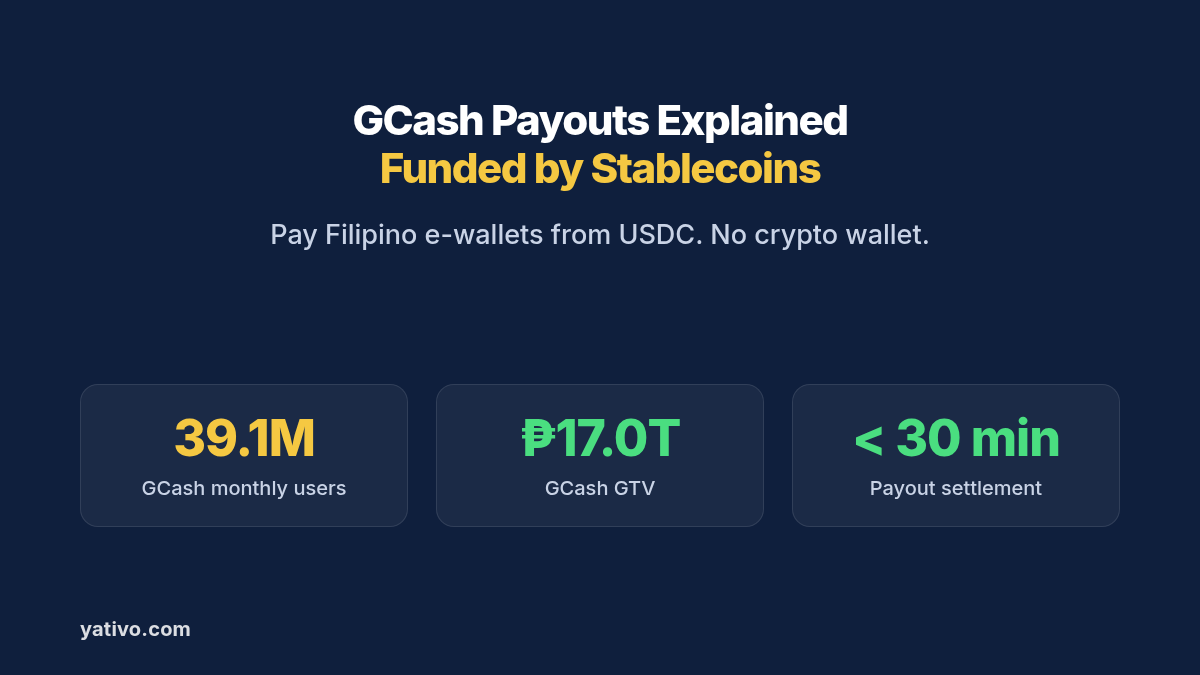
GCash payouts with stablecoin settlement let you pay that wallet from a USDC balance. You lock a quote, and pesos land in under 30 minutes.
Mynt, the company behind GCash, reported 39.1 million monthly active users and ₱17.0 trillion in gross transaction value. The wider InstaPay rail moved ₱11.554 trillion across 4.656 billion transactions in 2025.
This guide explains what GCash is, how it moves money, and how businesses fund GCash payouts with stablecoins through Yativo. It ends with dashboard steps and a full API example.
What Is GCash?
GCash is a mobile e-wallet in the Philippines, run by Mynt. Users hold pesos, pay bills, shop and send money from their phone.
A GCash account is tied to a mobile number. That number is all a sender needs to pay into it.
How GCash Works
GCash payouts credit the wallet directly. A few mechanics matter for payouts.
- Mobile number. The wallet is found by the 11-digit mobile number.
- Verified accounts. Fully verified wallets have higher limits.
- Wallet limits. Monthly incoming limits apply, so very large payments may suit a bank account.
- Cash out. Recipients can move funds to banks or spend directly.
Why Businesses Fund GCash Payouts with Stablecoins
Most businesses that pay over GCash from abroad face the same problem. The domestic rail is fast, but the cross-border leg in front of it is slow and expensive.
Correspondent banks add days. A SWIFT wire can pass through intermediaries before it reaches a bank that can send the GCash payment. Each hop can hold the money or take a fee.
Small payments lose the most. Sending small amounts across borders costs an average of 6.36% of the amount sent, according to the World Bank. Contractor and creator payouts feel that most.
Stablecoins remove the slow leg. With a stablecoin balance, value moves on-chain in minutes. A licensed local payout partner then sends the GCash payment from inside the country.
Many Filipino workers prefer a wallet to a bank account. Paying straight into GCash from USDC skips the international wire.
How GCash Payouts with Stablecoin Settlement Work on Yativo
Yativo is payment infrastructure, not a bank. We use stablecoins as the settlement layer between your balance and the local rail.
- You fund your Yativo float balance with a fiat or stablecoin deposit, such as USDC.
- You request a quote that shows the rate, the fees and the exact PHP amount.
- Yativo settles the payout value on-chain with a licensed local payout partner in the Philippines.
- The partner sends a GCash payment in PHP to the recipient’s GCash wallet.
- Your recipient sees the credit like any other domestic GCash payment.
Your recipient does not need a crypto wallet. They never see or touch stablecoins. On their side, it is a normal GCash payment.
Read more in our overview of the on-ramp and off-ramp API for businesses.
GCash Gateways on Yativo
Yativo pays GCash through gateway 1368. For a country-level guide, see GCash payouts in the Philippines.
PHP Local Wallet (gateway ID 1368)
Gateway 1368 pays Philippine e-wallets. Use payment_method gcash, from 100 to 999,999 PHP per payout.
Required details: the fields returned by the form for gateway 1368. Expect the holder name and mobile number.
Settlement time: Under 30 minutes.
Limits: 100 PHP minimum and 999,999 PHP maximum per payout in our catalog.
eWallets – Philippines
Gateway 1386 is an alternative e-wallet route that pays on behalf of your business. It requires a POBO endorsement on your account.
Settlement time: T+1 (next business day).
GCash vs Other Payout Rails
| GCash | PHP bank transfer | SWIFT wire | |
| Settlement on Yativo | Under 30 minutes | Under 30 minutes | T+1 |
| Identifier | Mobile number | Bank and account number | SWIFT/BIC and account |
| Per payout | 100 to 999,999 PHP | 100 PHP and up | Bank dependent |
How to Send a GCash Payout with Stablecoins via Yativo
Option 1: Dashboard (for manual payouts)
- Fund your Yativo float balance with either a fiat or a stablecoin deposit, such as USDC.
- Go to Transfer in your Yativo dashboard.
- Select the float wallet you are paying with, for example USD, EUR, MXN or whichever balance you funded.
- Choose the customer you are paying on behalf of. This step is necessary for fintechs that run payouts on behalf of their customers.
- Choose the Philippines as the destination and PHP Local Wallet as the payout method.
- Enter the recipient details the payout form asks for, such as the holder name and mobile number.
- Enter the amount in USD or PHP.
- Review the quote: exchange rate, fees, delivery time and the exact PHP amount your recipient receives.
- Confirm with your PIN and 2FA.
- Track the payout in real time and download the receipt for your records.
Option 2: API (for automated and bulk payouts)
Every endpoint below is in the Yativo API documentation. Production calls go to https://api.yativo.com/api/v1, and the sandbox runs at https://smtp.yativo.com/api/v1.
Authenticate every request with the X-Api-Key and X-Api-Secret headers. Each key only works from the server IPs listed on it, as covered in our October update. Every POST also needs a unique Idempotency-Key header.
Step 1. Generate a USDC deposit address on Solana to fund your balance:
POST https://api.yativo.com/api/v1/crypto/create-wallet
X-Api-Key: $YATIVO_API_KEY
X-Api-Secret: $YATIVO_API_SECRET
Idempotency-Key: 6cef4ded-49fe-4b95-b6e9-0db90a9ff04d
Content-Type: application/json

{
  "currency": "USDC_SOL"
}
Step 2. List the payout methods available for the Philippines:
curl "https://api.yativo.com/api/v1/payment-methods/payout?country=PHL" \
  -H "X-Api-Key: $YATIVO_API_KEY" \
  -H "X-Api-Secret: $YATIVO_API_SECRET" \
  -H "Accept: application/json"
PHP Local Wallet carries gateway ID 1368. Always read the ID from the live response instead of hardcoding it.
Step 3. Fetch the required fields for that gateway:
GET https://api.yativo.com/api/v1/beneficiary/form/show/1368
X-Api-Key: $YATIVO_API_KEY
X-Api-Secret: $YATIVO_API_SECRET
The response lists every required field and its accepted values. Build your payment_data object from it. For field details, see API documentation.
Step 4. Create the beneficiary. Replace the placeholder with the fields the form returned:
POST https://api.yativo.com/api/v1/beneficiaries/payment-methods/
X-Api-Key: $YATIVO_API_KEY
X-Api-Secret: $YATIVO_API_SECRET
Idempotency-Key: 45e805aa-6740-418d-bc69-e5bc402596f5
Content-Type: application/json

{
  "gateway_id": 1368,
  "nickname": "Maria Santos",
  "currency": "PHP",
  "customer_id": "e8caa491-57b6-4c39-9e3a-d2c97e47fbf0",
  "payment_data": {
    "{field_from_form}": "{value}"
  }
}
Step 5. Lock your rate. Quotes hold for 5 minutes:
POST https://api.yativo.com/api/v1/exchange-rate
X-Api-Key: $YATIVO_API_KEY
X-Api-Secret: $YATIVO_API_SECRET
Idempotency-Key: 79ef65e1-16de-46cd-985e-cd5cbef48aeb
Content-Type: application/json

{
  "from_currency": "USD",
  "to_currency": "PHP",
  "method_id": 1368,
  "method_type": "payout",
  "amount": 300
}
Step 6. Initiate the payout from your balance:
POST https://api.yativo.com/api/v1/wallet/payout
X-Api-Key: $YATIVO_API_KEY
X-Api-Secret: $YATIVO_API_SECRET
Idempotency-Key: 1723e445-4ced-4548-b285-4949d37b06f8
Content-Type: application/json

{
  "debit_wallet": "USD",
  "amount": 300,
  "payment_method_id": 8347,
  "customer_id": "e8caa491-57b6-4c39-9e3a-d2c97e47fbf0",
  "quote_id": "4a72ecf8-6c8a-4e38-9971-8aabe9f785ed"
}
Use the id from the beneficiary response as payment_method_id. For bulk runs, repeat the call per beneficiary, as described on our payouts page.
Best Practices for GCash Payouts
Confirm the wallet name. The name on GCash should match your records.
Mind wallet limits. For large sums, use PHP bank transfer gateway 1364 instead.
Batch small payouts. Wallet payouts suit frequent, smaller amounts to many recipients.
Lock the rate on large payouts. Quotes hold for 5 minutes, so request one right before you approve a big payment.
Use idempotency keys everywhere. A unique Idempotency-Key on every POST stops a retry from sending the same payout twice.
Frequently Asked Questions
What is a GCash payout?
A GCash payout is a peso transfer straight into a recipient’s GCash e-wallet, identified by their mobile number.
Does my recipient need a crypto wallet to receive a GCash payout?
No. Your recipient gets PHP in their normal GCash wallet over GCash. They never touch stablecoins.
Is it compliant to fund GCash payouts with stablecoins?
Yes, when the payout runs through regulated infrastructure. Yativo is registered with FinCEN as a Money Services Business, registration number 31000270723339. A licensed local payout partner sends the GCash payment. Your own tax and reporting duties still apply.
How long does a GCash payout take with Yativo?
GCash payouts via gateway 1368 settle in under 30 minutes. The POBO route 1386 settles T+1.
Which stablecoins can fund GCash payouts?
You can fund your float balance with USDC, or with fiat. EURC deposits credit your EUR balance, while USDC deposits credit your USD balance. The quote shows the conversion before you confirm.
Can I also pay Maya or GrabPay?
Yes. Gateway 1368 also lists Maya, GrabPay and ShopeePay as payment methods.
Start Sending GCash Payouts with Yativo
GCash serves 39.1 million monthly active users. Yativo lets you fund GCash payouts with USDC through a licensed local payout partner, settled in under 30 minutes. Book a demo to set up your first GCash payout, or contact sales if you already know your monthly volume.
Sources
- Mynt: GCash parent Mynt IPO filing
- BusinessWorld: InstaPay, PESONet transfers in 2025
- World Bank: Remittance Prices Worldwide
- Yativo: Yativo API Documentation
- Yativo: Safer API access, three new virtual accounts and new payment links